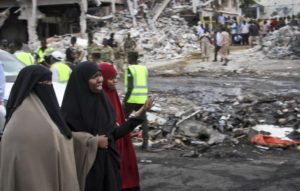
Somali women react at the scene of Saturday’s blast, in Mogadishu, Somalia Sunday, Oct. 15, 2017. The death toll from the most powerful bomb blast witnessed in Somalia’s capital rose Sunday to at least 189 with more than 200 injured, making it the deadliest single attack ever in the Horn of Africa nation, police and hospital sources said. (AP Photo/Farah Abdi Warsameh)
MOGADISHU, Somalia (AP) — The death toll from the most powerful bomb blast witnessed in Somalia’s capital rose to 231 with more than 275 injured, making it the deadliest single attack ever in this Horn of Africa nation, a senator said Sunday.
Abshir Abdi Ahmed cited doctors at hospitals he had visited in Mogadishu. Many of the bodies in mortuaries had not yet been identified, he said. Officials feared the toll would continue to climb from Saturday’s truck bomb that targeted a busy street near key ministries.
Doctors struggled to assist horrifically wounded victims, many burned beyond recognition. “The hospital is overwhelmed by both dead and wounded,” said Dr. Mohamed Yusuf, the director of Medina hospital. “This is really horrendous, unlike any other time in the past.”
Ambulance sirens echoed across the city as bewildered families wandered in the rubble of buildings, looking for missing relatives. “In our 10-year experience as the first responder in #Mogadishu, we haven’t seen anything like this,” the Aamin Ambulance service tweeted.
Grief overwhelmed many.
“There’s nothing I can say. We have lost everything,” wept Zainab Sharif, a mother of four who lost her husband. She sat outside a hospital where he was pronounced dead after hours of efforts by doctors to save him.
President Mohamed Abdullahi Mohamed declared three days of mourning and joined thousands of people who responded to a desperate plea by hospitals to donate blood. “I am appealing all Somali people to come forward and donate,” he said.
Angry protesters gathered near the scene of the attack as Somalia’s government blamed the al-Qaida-linked al-Shabab extremist group for what it called a “national disaster.” However, al-Shabab, which often targets high-profile areas of the capital with bombings, had yet to comment.
“They don’t care about the lives of Somali people, mothers, fathers and children,” Prime Minister Hassan Ali Khaire said. “They have targeted the most populated area in Mogadishu, killing only civilians.”
Rescue workers searched for survivors trapped under the rubble of the largely destroyed Safari Hotel, which is close to Somalia’s foreign ministry. The explosion blew off metal gates and blast walls erected outside the hotel.
The United States condemned the bombing, saying “such cowardly attacks reinvigorate the commitment of the United States to assist our Somali and African Union partners to combat the scourge of terrorism.”
But the U.S. Africa Command said U.S. forces had not been asked to provide aid. A spokesman told The Associated Press that first responders and local enforcement would handle the response and “the U.S. would offer assistance if and when a request was made.”
The U.S. military has stepped up drone strikes and other efforts this year against al-Shabab, which is also fighting the Somali military and over 20,000 African Union forces in the country.
The United Nations special envoy to Somalia called the attack “revolting,” saying an unprecedented number of civilians had been killed. Michael Keating said the U.N. and the African Union were supporting the Somali government’s response with “logistical support, medical supplies and expertise.”
Saturday’s blast occurred two days after the head of the U.S. Africa Command was in Mogadishu to meet with Somalia’s president, and two days after the country’s defense minister and army chief resigned for undisclosed reasons.