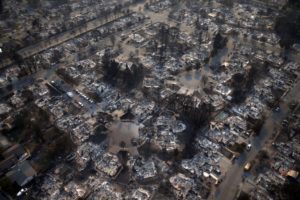
An aerial view shows the scope of fire destruction in the Coffey Park neighborhood of Santa Rosa in Northern California. Officials fear that some of the 22 separate blazes covering more than 265 square miles could merge into larger infernos. (Karl Mondon /San Jose Mercury News via AP)
SONOMA, Calif. (AP) — Gusting winds and dry air forecast for Thursday could drive the next wave of devastating wildfires that are already well on their way to becoming the deadliest and most destructive in California history.
Winds up to 45 mph (72 kph) were expected to pummel areas north of San Francisco where at least 23 people have died and at least 3,500 homes and businesses have been destroyed. The conditions could erase modest gains made by firefighters.
“It’s going to continue to get worse before it gets better,” state fire Chief Ken Pimlott said Wednesday.
Entire cities had evacuated in anticipation of the next round of flames, their streets empty, the only motion coming from ashes falling like snowflakes.
In Calistoga, a historic resort town known for wine tastings and hot springs, 5,300 people were under evacuation orders. Tens of thousands more have been driven from their homes by the flames. A few left behind cookies for firefighters and signs reading, “Please save our home!”
The 22 fires, many out of control, spanned more than 265 square miles (686 square kilometers) as the inferno entered its fourth day. Strategic attacks that have kept wildfire destruction and death tolls low in recent years haven’t worked against the ferocity of the blazes.
“We are literally looking at explosive vegetation,” Pimlott said.
“Make no mistake,” he added later, “this is a serious, critical, catastrophic event.”
Residents in the community of Boyes Hot Springs in Sonoma County were told to clear out Wednesday, and the streets were quickly lined with cars packed with fleeing people.
“That’s very bad,” resident Nick Hinman said when a deputy warned him that the driving winds could shift the wildfires toward the town of Sonoma, where 11,000 people live. “It’ll go up like a candle.”
The ash rained down one Sonoma Valley, covering windshields, as winds picked up. Countless emergency vehicles hurried toward the flames, sirens blaring, as evacuees sped away after jamming possessions into their cars and filling their gas tanks.
Officials voiced concern that the 22 separate blazes would merge into larger infernos.
“We have had big fires in the past. This is one of the biggest, most serious, and it’s not over,” Gov. Jerry Brown said at a news conference Wednesday, alongside the state’s top emergency officials.
They said 8,000 firefighters and other personnel were battling the blazes, with more resources pouring in from Arizona, Nevada, Washington and Oregon.
Flames have raced across the wine-growing region and the scenic coastal area of Mendocino farther north, leveling whole neighborhoods and leaving brick chimneys and charred appliances to mark the sites where homes once stood.
In Boyes Hot Springs, residents had watched ridges over the west side of town for days to gauge how close the orange flames had come. On Wednesday, the ridges were obscured by growing clouds of smoke.
With fires advancing from several sides in Sonoma Valley, law enforcement officers on loan from other areas barred residents of evacuated communities from returning to see how their homes and businesses had fared. Roadblocks were set up between Sonoma and devastated areas of Santa Rosa.
Alejandro Rodriguez had been evacuated from one tiny Sonoma Valley town, only to have deputies come to the neighborhood where he had relocated and tell residents to pack up and go.
“I want to see my house, see if anything’s left,” Rodriguez said, gesturing at officers at one roadblock. “They won’t tell us nothing.”
Sonoma County Sheriff Robert Giordano said hundreds of people had been reported missing. But officials believe many will eventually be found. Chaotic evacuations and poor communications over the past few days have made locating friends and family difficult.
The sheriff expects the death toll to climb.
“The devastation is enormous,” he said. “We can’t even get into most areas.”
Helicopters and air tankers were assisting thousands of firefighters trying to beat back the flames. Until now, the efforts have focused on “life safety” rather than extinguishing the blazes, partly because the flames were shifting with winds and targeting communities without warning.
Fires were “burning faster than firefighters can run, in some situations,” Emergency Operations Director Mark Ghilarducci said.
In Southern California, cooler weather and moist ocean air helped firefighters gain ground against a wildfire that has scorched nearly 14 square miles (36 sq. kilometers).
Orange County fire officials said the blaze was 60 percent contained.
___