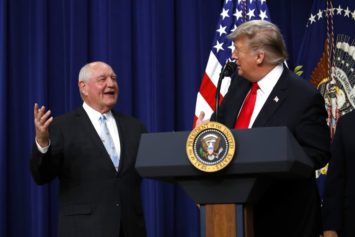
U.S. Secretary of Education Betsy DeVos talks with students during a high school football (AP Photo/Darron Cummings)
WASHINGTON (AP) — The Trump administration on Friday scrapped Obama-era guidance on investigating campus sexual assault, replacing it with new instructions that allow universities to require higher standards of evidence when handling complaints.
DeVos has said that Obama’s policy had been unfairly skewed against those accused of assault and had “weaponized” the Education Department to “work against schools and against students.”
The change is the latest in Trump’s broader effort to roll back Obama policies. Women’s rights groups slammed Friday’s decision, saying it will discourage students from reporting assault.
The guidance released in 2011 and then updated in 2014 instructed universities to use a “preponderance of the evidence” standard when assessing and investigating a claim of sexual assault.
DeVos’ new interim guidelines let colleges choose between that standard and a “clear and convincing evidence” standard, which is harder to meet. Those rules will be in place temporarily while the Education Department gathers comments from interest groups and the public and writes new guidance.
“This interim guidance will help schools as they work to combat sexual misconduct and will treat all students fairly,” DeVos said in a statement.
“Schools must continue to confront these horrific crimes and behaviors head-on. There will be no more sweeping them under the rug. But the process also must be fair and impartial, giving everyone more confidence in its outcomes,” she said.
Andrew Miltenberg, a New York lawyer who represents students accused of sexual assault, described Obama’s standard as only “50.1 percent certain” and said that it ignored the presumption of innocence and put the burden on the accused to prove that the assault did not happen. Miltenberg said the system proposed by DeVos is much more fair.
“Certainly, it’s a much more stringent standard and one that is less open to subjective interpretation,” Miltenberg said.
A student may choose whether to report a claim of assault to police or to have it investigated by a university under a federal provision against sexual discrimination. Many students choose not to turn to law enforcement because many such cases go unprosecuted as police and the courts require higher standards of evidence. Also, many victims are traumatized and may feel more comfortable to deal with university investigators rather than with police.
The Education Department’s Office for Civil Rights is currently investigating 360 sexual violence cases under investigation at 258 postsecondary institutions. The Department said that any agreements have already been reach with schools as part of investigations that have already been completed will stay in place, while continuing investigations may be reevaluated.
Women’s rights advocates lashed out at Friday’s change.
Fatima Goss Graves, President and CEO of the National Women’s Law Center, said the new rule will have “devastating” impact on students and schools.
“It will discourage students from reporting assaults, create uncertainty for schools on how to follow the law, and make campuses less safe,” Graves said in a statement. “This misguided directive is a huge step back to a time when sexual assault was a secret that was swept under the rug.”
Senator Patty Murray of Washington, the senior Democrat on the Senate’s committee on education, said DeVos’ decision “may cause survivors of sexual assault to go back into the shadows, allowing predators to continue to roam college campuses and the epidemic of college sexual assault to spread.”
The department did not say how long the interim rule is expected to be in effect. Clare McCann, a higher education expert with the New America think tank, said it will likely take the department more than a year to finalize a new rule.