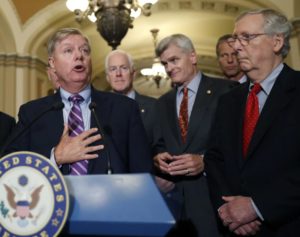
Sen. Lindsey Graham, R-S.C., speaks to the media, accompanied by Senate Majority Whip Sen. John Cornyn, R-Texas, Sen. Bill Cassidy, R-La., Sen. John Thune, R-S.D., and Senate Majority Leader Mitch McConnell of Ky., on Capitol Hill, (AP Photo/Alex Brandon)
WASHINGTON (AP) — With time growing short, President Donald Trump and Republican Senate leaders are engaged in a frantic search for votes in a last-ditch effort to repeal and replace the Obamacare health law. The outcome is uncertain in a Capitol newly engulfed in drama over health care.
Senate Majority Leader Mitch McConnell, whose failure to pass a repeal bill in July opened a bitter public rift with Trump, is pressing hard for the newly revived effort, which had been left for dead as recently as a week or two ago. But in a sign he remained short of votes, McConnell refused on Tuesday to commit to bringing the legislation up for a vote.
As in July, much of the focus was on Sen. John McCain, R-Ariz.
Would he step back in line with fellow Republicans now that there was a bill co-written by Sen. Lindsey Graham, R-S.C., his best friend in the Senate? McCain wasn’t saying. Sen. Lisa Murkowski, R-Alaska, another crucial vote, wasn’t disclosing her views, either.
Republicans must act by Sept. 30 in the Senate or face the prospect of a Democratic filibuster.
That blocking action is currently staved off by budget rules that will expire at the end of the month. The new legislation, by Graham and Sen. Bill Cassidy, R-La., would undo the central pillars of former President Barack Obama’s law and replace them with block grants to the states so they could make their own health care coverage rules.
“I hope Republican Senators will vote for Graham-Cassidy and fulfill their promise to Repeal & Replace ObamaCare. Money direct to States!” Trump said in a tweet Wednesday.
McConnell, in remarks on the Senate floor, had said: “Governors and state legislators of both parties would have both the opportunity and the responsibility to help make quality and affordable health care available to their citizens in a way that works for their own particular states.” He called it “an intriguing idea and one that has a great deal of support.”
Democrats are unanimously opposed, arguing that the legislation would result in millions of Americans losing their health insurance, decreased access to affordable care and a damaged Medicaid health program for the poor.
McConnell must win the votes of 50 of the 52 Senate Republicans. That would amount to victory in the 100-member Senate, because GOP Vice President Mike Pence would then break a tie.
Pence appeared at the Capitol on Tuesday and declared the Trump administration was “all-in” on the effort. The president himself was closely in touch with Graham and others.
If the bill does pass, Speaker Paul Ryan, R-Wis., has committed to pushing it through the House as-is, and straight to the president’s desk, according to Graham.
After seven years of promises to get rid of Obama’s law, Republicans would have finally succeeded. It would be a promise kept to the GOP base, yet one with uncertain and potentially devastating political consequences for the Republican Party given that millions of people would be likely to lose their health coverage and others might have skimpier care.
The bill would let states set their own coverage requirements, allow insurers to boost prices on people with serious medical conditions, end Obama’s mandates that most Americans buy insurance and that companies offer coverage to workers, and cut and reshape Medicaid.
The bill’s full impacts are difficult to predict because the Congressional Budget Office has not had time to assess it. But senators plan to move forward without a complete CBO assessment, heightening outrage from Democrats.
By Tuesday evening the legislation remained at least one or two votes short.
The situation is nearly identical to where Republicans found themselves in July when McConnell, R-Ky., made one last attempt to pass a stripped-down repeal bill. It failed in a tense late-night session, with McCain, newly diagnosed with brain cancer, casting the decisive “no” vote.
McCain has been more than willing to buck his party’s leadership over the years, and to defy Trump. Undercutting Graham might be a different issue, and McCain brusquely refused to tip his hand Tuesday.
“I don’t have anything to say,” McCain said repeatedly, snapping at a reporter who pressed for more. “I have nothing to say, do you hear me?”
Graham made clear he was arguing the case forcefully to his longtime friend. A hearing on the legislation was scheduled for next week after McCain had complained there weren’t any.
“I know he likes federalism, I know he wants bipartisanship, but I just don’t personally see a bipartisan proposal that’s got a snowball’s chance in hell of doing anything other than propping up Obamacare,” Graham said.
Graham said: “It’s either this or a march toward Bernie-care,” a reference to Sen. Bernie Sanders’ Medicare-for-all bill.
GOP Sen. Rand Paul of Kentucky has announced his opposition to the legislation, saying it doesn’t go far enough in repealing Obama’s law, while moderate GOP Sen. Susan Collins of Maine, who opposed earlier repeal bills, also sounded like a “no” Tuesday. She said the Graham-Cassidy bill could be worse than earlier versions because of potential harm to people with pre-existing conditions.
Trump went after Paul on Twitter on Wednesday: “Rand Paul is a friend of mine but he is such a negative force when it comes to fixing healthcare. Graham-Cassidy Bill is GREAT! Ends Ocare!”
In addition to McCain, the focus was on moderate Murkowski, the third “no” on the earlier bill along with Collins and McCain.
In what could be a significant factor for her, Alaska’s independent governor, Bill Walker, joined a bipartisan letter with other governors in opposition to the bill, asking senators to instead focus on bipartisan approaches. A pair of potent interest groups, the American Medical Association and AARP, also declared opposition.
But the prospect for any kind of bipartisanship appeared to die altogether as GOP Sen. Lamar Alexander announced he had not found consensus in his attempt for a limited fix for existing health marketplaces. His Democratic partner, Sen. Patty Murray, accused the Republican leadership of freezing their effort.


