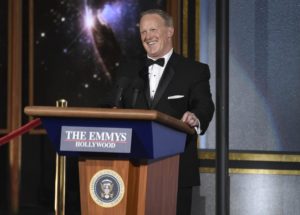
Sean Spicer speaks at the 69th Primetime Emmy Awards on Sunday, Sept. 17, 2017, at the Microsoft Theater in Los Angeles. (Photo by Chris Pizzello/Invision/AP)
NEW YORK (AP) — Sean Spicer says his surprise Emmy Awards appearance was a chance to have some fun and suggested Tuesday that people who were upset by it were taking things too seriously.
Clearly, not everyone was laughing, however. For Emmys host Stephen Colbert, there’s also a risk that a joke he engineered could wind up doing collateral damage.
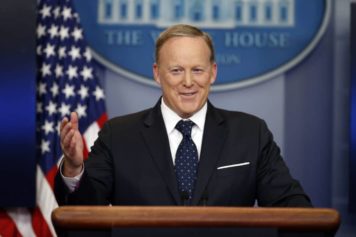
The former White House press secretary’s cameo was Colbert’s idea, and they arranged to maximize the surprise factor through Chris Licht, the Colbert producer who knew Spicer from his background in news. Colbert set the joke up by saying there was no way of knowing how many people would be watching the Emmys, then Spicer wheeled out from behind a podium to say “this will be the largest audience to witness an Emmys period, both in person and around the world.”
The clear reference was to Spicer’s first appearance in the White House press room, arguing against photographic evidence about how large President Donald Trump’s Inauguration Day audience was. (In an unfortunate parallel, Emmy viewership on Sunday essentially tied last year with the smallest ever for the television awards show).
Trump critics resented the apparent effort to “normalize” Spicer and make light of the idea of not telling the truth in the White House press room.
“The message of his presence was not only that we can all laugh at his service and sycophancy in the Trump administration, but that he’s willing to laugh with us,” wrote Frank Bruni in a column for The New York Times titled “The Shameful Embrace of Sean Spicer at the Emmys.”
On “The View,” Joy Behar said that if Spicer and other Trump surrogates apologize to the American people, “then I’ll have fun with you, Sean.”
Liberal commentator Keith Olbermann tweeted that the Emmys lost its credibility by lionizing Spicer. Even a Republican strategist, Kevin Madden, warned on CNN that Spicer should be wary of equating notoriety with respect.
To which Spicer, reached on an airplane on Tuesday, offered a suggestion: lighten up.
“People are reading too much into this,” he said. While he respects people’s opinions, he said people shouldn’t take the appearance that seriously.
Spicer made the rounds of Hollywood parties after the Emmys and was greeted with many people asking for selfies.
“I was surprised at how nice people were to me,” he said, “even the people who I know don’t agree with me politically.”
Some fans of Colbert were also bewildered by the appearance. The “Late Show” host has soared in the ratings this year with comedy that has been sharply critical of Trump and his team. He should know the dangers of appearing too chummy: late-night competitor Jimmy Fallon still hasn’t recovered from the bad feelings engendered when he tousled Trump’s hair when the then-candidate appeared on the “Tonight” show last year.
After Spicer’s appearance, Colbert got in a rip. He joked that Robert DeNiro, who appeared as Bernard Madoff in the HBO movie “Wizard of Lies,” had actually been the star of “The Sean Spicer Story.”
Emily Nussbaum, television critic for The New Yorker, tweeted after that one: “having cake, eating it too, then throwing it up again. There’s a lot going on.”
The website Vox said it was “incredibly disappointing” to see Colbert joking with Spicer.
“It went against everything Colbert purports to do on his fiercely pointed ‘Late Show,’ and retroactively sucked the air out of any biting Trump jokes he tried to make in his opening monologue,” the site wrote.