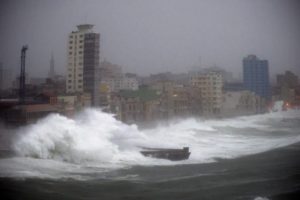
Strong waves brought by Hurricane Irma hit the Malecon seawall in Havana, Cuba, late Saturday, Sept. 9, 2017. (AP Photo/Ramon Espinosa)
CAIBARIEN, Cuba (AP) — Hurricane Irma ripped roofs off houses, collapsed buildings and flooded hundreds of miles of coastline as it raked Cuba after cutting a trail of destruction across the Caribbean. It has killed at least 22 people and has officials scrambling to bring aid on Sunday.
As Irma left Cuba and directed its 130 mph (215 kph) winds toward Florida, authorities on the island were warning of staggering damage to keys along the northern coast studded with all-inclusive resorts and cities, as well as farmland in central Cuba.
There were no immediate reports of deaths in Cuba – a country that prides itself on its disaster preparedness – but authorities were trying to restore power, clear roads and warning that people should stay off the streets of Havana because flooding could continue into Monday.
Residents of “the capital should know that the flooding is going to last more than 36 hours, in other words, it is going to persist,” Civil Defense Col. Luis Angel Macareno said late Saturday, adding that the waters had reached at about 2,000 feet (600 meters) into parts of Havana.
As Irma rolled in, Cuban soldiers went through coastal towns to force residents to evacuate, taking people to shelters at government buildings and schools — and even caves.
Video images from northern and eastern Cuba showed uprooted utility poles and signs, many downed trees and extensive damage to roofs. Witnesses said a provincial museum near the eye of the storm was in ruins. And authorities in the city of Santa Clara said 39 buildings collapsed.
More than 5,000 tourists were evacuated from the keys off Cuba’s north-central coast, where the government has built dozens of resorts in recent years.
Civil Defense official Gregorio Torres said authorities were trying to tally the extent of the damage in eastern Cuba, home to hundreds of rural communities.
In Caibarien, a small coastal city about 200 miles (320 kilometers) east of Havana, winds downed power lines and a three-block area was under water. Many residents had stayed put, hoping to ride out the storm.
Before slamming into Cuba, Irma had caused havoc in lush Caribbean resorts such as St. Martin, St. Barts, St. Thomas, Barbuda and Anguilla, where many residents said they felt abandoned by officials.
The spokesman for France’s government, Christope Castaner, said in an interview with Europe1-CNews-Les Echos on Sunday that he “perfectly (understood) the anger” of people on the Caribbean islands.
But he defended the government response, saying emergency help was given “first priority.”
Castaner said that many islanders were suffering from “an impact of emotional shock, an impact that’s extremely hard psychologically.”
With power out to much of the French Caribbean region, France’s main electricity provider, EDF, said it has flown 140 tons of generators, pumps and other equipment to help St. Martin and St. Barts.
Many of Irma’s victims fled their battered islands on ferries and fishing boats for fear Hurricane Jose would destroy or drench anything Irma left untouched. But that hurricane veered to the north without doing much damage.
On the Dutch side of St. Martin, an island divided between French and Dutch control, an estimated 70 percent of the homes were destroyed by Irma, according to the Dutch government.
Prime Minister William Marlin said about 1,600 tourists had been evacuated and efforts were being made to move 1,200 more.
Marlin said many countries and people have offered help to St. Maarten, but authorities were waiting for the weather conditions to see how it could be coordinated. Authorities are still trying to determine the extent of damage to the island but he said 28 police officers lost homes during the storms.
The U.S. State Department worked with the Defense Department to help more than 1,200 Americans fly out of the Dutch side of St. Martin, starting with those in need of urgent medical care, spokeswoman Heather Nauert said.
Carol Basch, a 53-year-old tourist from Savannah, Georgia, took refuge during the storm in the bathroom of her St. Martin hotel room after windows shattered. She stayed there praying for about four hours, surrounding herself with pillows.
“I kept saying, ‘Lord, please stop this, and soon, soon,'” said Basch, who was evacuated to Puerto Rico. “I’m glad I’m alive. I didn’t think I was going to make it.”
France and the Netherlands said their islands in the Caribbean were spared major damage from Jose, which passed farther away from the islands than expected.
The U.S. National Hurricane Center downgraded a hurricane warning for Barbuda and Anguilla. A hurricane watch also was discontinued for nearby Antigua.
In a tweet, the Dutch navy said the security situation on St. Maarten, which saw widespread looting and robberies after Hurricane Irma, had improved thanks to patrols by marines and police flown to the island to help overwhelmed local law enforcement.


