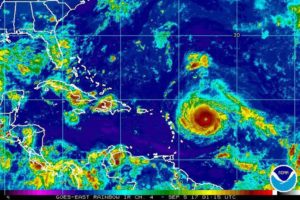
National Oceanic and Atmospheric Administration radar shows Hurricane Irma nearing the eastern Caribbean. Irma grew into a powerful Category 4 storm Monday. (NOAA via AP)
SAN JUAN, Puerto Rico (AP) — Hurricane Irma strengthened into a dangerous Category 5 storm Tuesday as it roared toward the northeast Caribbean on a path that could take it to the United States.
The U.S. National Hurricane Center said Irma had sustained winds of 175 mph (280 kph) and was centered about 270 miles (440 kilometers) east of Antigua. It was moving west at 14 mph (22 kph).
The center said there was a growing possibility that the storm’s effects could be felt in Florida later this week and over the weekend, though it was still too early to be sure of its future track: “Everyone in hurricane-prone areas should ensure that they have their hurricane plan in place.”
Irma’s center was expected to move near or over the northern Leeward Islands late Tuesday and early Wednesday, the hurricane center said. The eye was then expected to pass about 50 miles (80 kilometers) from Puerto Rico late Wednesday.
Authorities warned that the storm could dump up to 10 inches (25 centimeters) of rain, cause landslides and flash floods and generate waves of up to 23 feet (7 meters). Government officials began evacuations and urged people to finalize all preparations as shelves emptied out across islands including Puerto Rico.
“The decisions that we make in the next couple of hours can make the difference between life and death,” Puerto Rico Gov. Ricardo Rossello said. “This is an extremely dangerous storm.”
Residents on the U.S. East Coast were urged to monitor the storm’s progress in case it should turn northward toward Florida, Georgia or the Carolinas.
“This hurricane has the potential to be a major event for the East Coast. It also has the potential to significantly strain FEMA and other governmental resources occurring so quickly on the heels of [Hurricane] Harvey,” Evan Myers, chief operating officer of AccuWeather, said in a statement.
In the Caribbean, hurricane warnings were issued for 12 island groups, including the British Virgin Islands, where the governor urged people to evacuate the tiny island of Anegada if they could ahead of the storm.
Vivian Wheatley, proprietor of the Anegada Reef Hotel, planned to stay behind. She said she would stay in one of the hotel rooms and take advantage of the generator since there were no guests.
“We know it’s a very powerful [storm], and we know it’s going to be very close,” she said. “Let’s hope for the best.”
People in the U.S. territory of Puerto Rico braced for blackouts after the director of the island’s power company predicted that storm damage could leave some areas without electricity for four to six months. But “some areas will have power [back] in less than a week,” Ricardo Ramos told radio station Notiuno 630 AM.
The utility’s infrastructure has deteriorated greatly during a decade-long recession, and Puerto Ricans experienced an island-wide outage last year.
Both Puerto Rico and the U.S. Virgin Islands expected 4 inches to 8 inches (10-20 centimeters) of rain and winds of 40-50 mph with gusts of up to 60 mph.
“This is not an opportunity to go outside and try to have fun with a hurricane,” U.S. Virgin Islands Gov. Kenneth Mapp warned. “It’s not time to get on a surfboard.”
A hurricane warning was posted for Antigua and Barbuda, Anguilla, Montserrat, St. Kitts and Nevis, St. Martin, Saba, St. Eustatius, St. Maarten and St. Barts, Puerto Rico, and the U.S. and British Virgin islands. A tropical storm warning was in effect for Guadeloupe and Dominica.
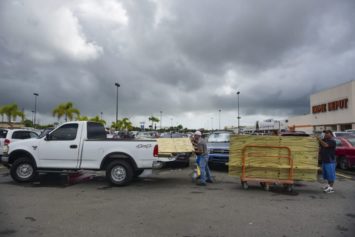
Meanwhile in Florida, residents took advantage of the Labor Day holiday to empty many store shelves of drinking water and other supplies in advance of the storm. Also Monday, Florida Gov. Rick Scott declared a state of emergency for the state’s 67 counties to give local governments “ample time, resources and flexibility” to prepare.
An earlier version of this report incorrectly said the island of Anegada was part of Antigua instead of the British Virgin Islands.