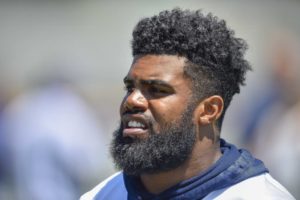
Ezekiel Elliott’s appeal of his six-game suspension over a domestic violence incident is headed for a second day with no timeline for completion of the hearing. (AP Photo/Gus Ruelas, File)
The NFL players’ union sued the league on behalf of Ezekiel Elliott late Thursday night, seeking to vacate the upcoming ruling of an arbitrator on the appeal of the Dallas running back’s six-game suspension in a domestic violence case.
The lawsuit, filed in federal court in Texas, accuses the NFL’s appeal process of being “fundamentally unfair” because arbitrator Harold Henderson denied a request to have Elliott’s ex-girlfriend testify at a hearing that wrapped up earlier Thursday.
The suit also claims that NFL executives hid information that was favorable to Elliott before Commissioner Roger Goodell imposed the punishment Aug. 11.
The lawsuit accuses NFL special counsel Lisa Friel of withholding from Goodell the word of co-lead investigator Kia Roberts, who the suit says concluded that the accuser wasn’t credible and that discipline wasn’t warranted.
“The withholding of this critical information from the disciplinary process was a momentous denial of the fundamental fairness required in every arbitration and, of course, does not satisfy federal labor law’s minimal due process requirements,” the lawsuit said.
Henderson is supposed to rule on the NFL’s decision to suspend Elliott “as soon as practicable,” according to the labor agreement.
Elliott, the NFL’s 2016 rushing leader as a rookie, was suspended after the league concluded he used physical force last summer in Ohio against Tiffany Thompson, his girlfriend at the time. Prosecutors didn’t pursue the case, citing conflicting evidence.
Elliott denied the allegations under oath in the appeal hearing, according to the lawsuit. The NFL didn’t immediately respond to a request for comment.
The lawsuit says the union and Elliott’s representatives plan to file for a temporary restraining order in hopes of making Elliott eligible for the season opener Sept. 10 against the New York Giants.
The NFL’s personal conduct policy was amended three years ago to stiffen penalties in domestic cases. Friel was hired as a result of the changes, which came after NFL was sharply criticized for its handling of a case involving former Baltimore running back Ray Rice.
The lawsuit also cited Henderson’s refusal to require Goodell to testify. According to the labor agreement, Goodell can choose from a list of arbitrators for appeals.
Henderson has heard dozens of appeals, including New Orleans running back Adrian Peterson’s in a child abuse case out of Texas when Peterson was with Minnesota. Henderson denied Peterson’s appeal of a suspension, but a federal judge overturned Henderson’s ruling.
The lawsuit claims that Roberts’ conclusions weren’t shared with four outside experts who advised Goodell before the ruling, and the suit makes broad claims of a “league-orchestrated conspiracy by senior NFL executives.”
According to the letter Elliott received informing him of the suspension three weeks ago, the NFL believed he used “physical force” three times in a span of five days in a Columbus, Ohio, apartment last July resulting in injuries to Thompson’s face, neck, shoulders, arms, hands, wrists, hips and knees.
Prosecutors in Columbus decided about a year ago not to pursue the case in the city where Elliott starred for Ohio State, but the NFL kept the investigation open. The league said its conclusions were based on photographs, text messages and other electronic evidence.
The lawsuit says Roberts prepared a document detailing inconsistencies in the accounts of Thompson, who the suit said was interviewed six times by Roberts.
“Presumably, the commissioner would have reached a very different disciplinary conclusion — one of exoneration and no discipline — had he known about the evidence which Friel and other unidentified, high-ranking NFL executives chose to conceal from the disciplinary process,” the lawsuit said.


