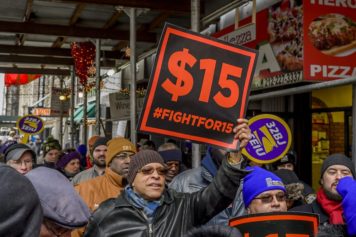
St. Louis city workers were slated to see their wages increase to $11 per hour in January 2018. (Photo by Spencer Platt/Getty Images)
After a brief increase to $10 an hour, St. Louis’ minimum wage has fallen back to $7.70, thanks to a new bill approved by Missouri Gov. Eric Greitens.
In July, Greitens voiced his opposition to efforts aimed at raising the minimum wage, saying such a move would ultimately “kill jobs.”
“And despite what you hear from liberals, it will take money out of people’s pockets,” Greitens was quoted as saying by the St. Louis Post-Dispatch.
In 2015, St. Louis passed an ordinance requiring that the city’s minimum wage increase to $10 an hour by 2017, according to Business Insider. The move sparked a court battle between Missouri’s state legislature and the city of St. Louis, but the city’s minimum wage did jump to $10 in May 2017.
The wage hike was a welcome change for thousands of workers who looked forward to the extra earnings to support themselves and their families. City workers were also slated to enjoy a slight increase to $11 an hour come January 2018, but their hopes for more money soon faded after the state legislature approved a bill prohibiting cities from setting a higher minimum wage than the rest of the state.
That law went effect Monday, Aug. 28. Now, the more than 30,000 workers who saw their wages jump to $10 an hour will see it shrink back to just $7.70.
Wanda Roberts, a minimum-wage worker in St. Louis, told CBS News that the new $10 wage earned her an extra $400 a month and benefited the local economy. Now that it’s being reversed, Roberts said she’ll have to “go back to struggling.”
“Trying to worry about how I’m going to pay my rent, how I’m going to pay my bills and how I’m going to have money left over to buy household supplies and food,” she said.
Ben Poremba, a St. Louis chef who owns four restaurants, agreed that lowering the minimum wage isn’t the way to go, especially considering the high cost of living.
“The cost of living is rising, but not the pay, so it’s morally important not to lower the minimum wage,” Poremba, who vowed to keep the minimum wage at $10, told the Los Angeles Times. “I want to debunk the notion that it’s not good for business. And if smaller businesses can afford it, then big retailers and fast-food companies can as well.”
The reversal comes as cities and states across the country are working to increase their minimum wages. Just last year, California Gov. Jerry Brown vowed to raise the state’s minimum wage to $15 by 2022. Similar “Fight for $15” campaigns are currently ongoing in several states, including Massachusetts, New Jersey and Rhode Island, according to The Daily Dot.