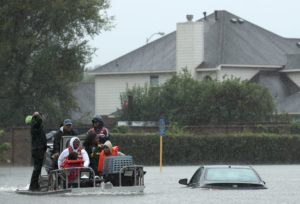
Houston police and firefighters have gotten over 6,000 calls for rescues and have saved more than 1,000 people since Hurricane Harvey hit. (Photo by Win McNamee/Getty Images)
As Hurricane Harvey continues its path of destruction across southeastern Texas, those confined to low-income, nonwhite communities are among the storm’s most vulnerable victims.
The hurricane, now downgraded to a tropical storm, has claimed the lives of eight people and dropped more than 25 inches of rain since making landfall Friday, Aug. 25, according to state officials. Forecasters expect many more inches to fall — 25 more to be exact — in the coming days, as thousands of locals remain stranded in their homes and the flood waters continue to rise.
The Washington Post reported that nearly 2,000 people had been taken to safety, with thousands more still in need of emergency assistance.
The immediate focus has remained on Houston, however, which has seen unprecedented flooding and damage in the wake of Harvey. The National Weather Service said Monday, Aug. 28, that parts of Harris County, which includes Houston, were hit with 30 inches of rain in just 72 hours.
Residents living in poor, nonwhite communities are likely to be the worst affected in such destructive storms like Harvey, as they lack the resources and ability needed to evacuate, according to a report by The Atlantic. To make matters worse, these residents often dwell in segregated neighborhoods where the risk for flooding is the highest, or that are next to toxic petrochemical plants that can overflow during a storm.
Disaster historian Jacob Remes addressed the social disparities in a tweet Sunday, writing, “We will hear claims about how disasters don’t discriminate by race or class. This is a lie.”
“Because disasters are social, they do,” Remes added.
Since Harvey hit, Houston Mayor Sylvester Turner has faced criticism over his failure to order evacuations in some Houston neighborhoods before the storm brought torrential downpours to the area.
“You literally cannot put 6.5 million people on the road,” Turner said at a press conference. “If you think the situation right now is bad, you give an order to evacuate, you are creating a nightmare.
“It has to be coordinated,” he added. “If it’s not done right, you are putting people in harm’s way and creating a far worse situation.”
The mayor noted that city officials anticipated heavy rains and said the best place for people to be was inside their homes.
Local station KPRC-TV reported that Houston police and firefighters have received more than 6,000 calls for rescues, and have saved more than 1,000 people as Tropical Storm Harvey bore down on the Bayou City. Turner added that 911 dispatchers have fielded more than 56,000 calls since 10 p.m. Saturday.
Though the worst of it may be over, Texas and surrounding cities aren’t out of the woods just yet. Heavy rainfall is expected to continue through the end of the week, forecasters said.
“We have not seen an event like this,” William “Brock” Long of the Federal Emergency Management Agency said Monday. “You could not draw this forecast up. You could not dream this forecast.”