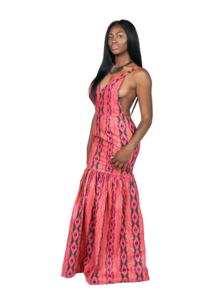
(Breanna Moore)
The hottest trends in African fashion are now just a click away, thanks to Breanna Moore and her fashion line LaBré. Designed to share the unique beauty of West African style with the rest of the world, LaBré’s purpose is to spread the richness and ingenuity of African fashion while simultaneously increasing the economic growth of Ghana.
Born and raised in Sumter, S.C., Moore always had big plans. “Ever since I was little, I always knew that I wanted to go to an Ivy League school,” she said. After attending the College of Charleston her freshman year, she made good on that wish, transferring to the University of Pennsylvania. “Cornell was too cold,” she said, the first of many jokes the amiable Moore would crack.
While at Penn, Moore had the opportunity to twice study abroad in Ghana, which she credits with her initial infatuation with African fashion. “This is beautiful,” Moore remembered thinking after she was first exposed to Kente cloth, the silk and cotton fabric made of interwoven cloth strips native to South Ghana. “Why don’t we know about this? This should be everywhere.”
Not only did Moore see an opportunity to spread the richness of African culture, she also saw an innovative way to create jobs in Ghana. “Kente cloth is expensive, so Ghanaians don’t wear it that frequently,” Moore said, citing the tradition of “Cultural Fridays,” the day of the week when many Ghanaians choose to dress up and wear Kente cloth. “It’s not that popular during the week, but I knew it had the potential to be, especially on a global scale.
“If I had a fashion line this would make more jobs for the tailors, so I’m gonna do it.”
Since then, Moore has done just that. The road to her first fashion line, however, was not necessarily easy. As graduation drew closer, her mother encouraged her to get a 9-to-5 job, but Moore had other plans.
“I thought it was gonna be easy!” Moore said, slightly mocking her own naiveté. After graduating in 2015, she began creating a business plan, worked two part-time jobs and soon applied for a small loan, all in the hopes of getting LaBré off the ground. She got the loan in the winter of 2015 and debuted the first collection online in July of 2016.
Since then, Moore has been working on her second collection, thanks to a successful campaign on Kickstarter. “That was a job within itself,” Moore said of the fundraising effort. “You have to email people every day. Text people. Get people to share it. Lots of reaching out.” Moore describes the day she hit her goal of $10,000 goal as “a blessing.” “It was great to see [via Kickstarter] that people felt that what I was doing was worthy and they wanted [LaBré] to grow,” she said.
What made LaBré stand out among fledgling businesses on Kickstarter was its commitment to hiring Ghanaian seamstresses and tailors. Named after Moore and her sister La’Yvette, LaBré is deeply committed to contributing to the economic growth of Ghana by creating job opportunities, specifically for Ghanaian women.
“Everything is made on the ground in Ghana,” Moore said. “It’s important that everything is made on the ground there. We give the seamstresses and tailors standard raises and we don’t bargain or make the prices lower than whatever they say it’s worth.
“People say that it would be cheaper to do it in China, but it would disregard the whole reason we are doing it in the first place.”
Since its launch a year ago, Moore has not only turned LaBré into a fashion brand in its own right, but she also has launched LaBré Bazaar, a separate online platform for other African artisans and designers to sell their clothing and products on an international scale.
Her next venture is LaBré Agency, launching in early October, an initiative to get clothing from designers from the African diaspora into already established retail shops. Launching in October, she’s already begun by form partnerships with Gap and Urban Outfitters in Philadelphia, letting them know what her mission is and why they should stock African clothing.
“My dream is to one day open up a whole department store that is nothing but African clothing,” Moore concluded. “The same way that I walk into an H&M or an Urban Outfitters, I want to be able to do with the same thing with African clothes.”
You can follow LaBré on Facebook, Twitter and Instagram and purchase LaBré designs at www.shoplabre.com


