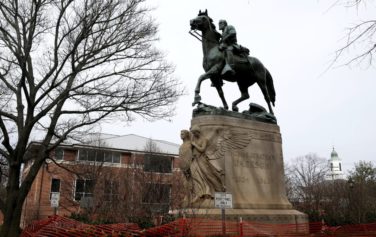
City workers prepare to drape a tarp over the statue of Confederate Gen. Thomas “Stonewall” Jackson in Justice Park in Charlottesville, Va. (AP Photo/Steve Helber)
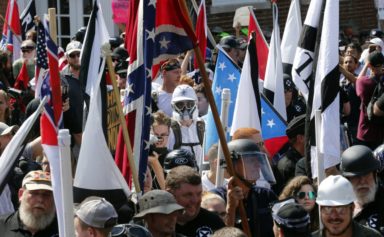
CHARLOTTESVILLE, Va. (AP) — Charlottesville residents are getting a chance to talk with city officials about a white nationalist rally earlier this month that devolved into deadly violence.
The city is hosting what it calls a “community recovery town hall” Thursday evening, in collaboration with the Community Relations Services of the Department of Justice. Officials will provide an update on “recovery efforts” and offer opportunities for public comment, according to a news release.
“Our community has been shaken to its core,” City Manager Maurice Jones said in a statement. “We see this partnership with CRS as the beginning of a process of recovery and renewal.”
The event comes a day after workers covered two Confederate statues in black to mourn the death of a woman who was killed while protesting the rally.
It’s been nearly two weeks since the event, which attracted what’s believed to be the largest gathering of white nationalists in at least a decade.
Rally attendees and counter-protesters fought in the streets. Heather Heyer was killed when a car plowed into demonstrators during a march, and two state troopers died in a helicopter crash that day.
Some residents have criticized city officials for granting a permit for the rally, and others have said police didn’t do enough to keep the two sides apart or stop the fighting.
City officials already got some feedback at a council meeting earlier this week when scores of people packed the chamber, shouting and cursing at members. The angry crowd forced the council to abandon its agenda. Instead, the panel heard hours of public comment.
In other developments Wednesday, Christopher Cantwell, a white nationalist from Keene, New Hampshire, turned himself in to face three felony charges in Virginia, authorities said. Cantwell was wanted by University of Virginia police on two counts of the illegal use of tear gas or other gases and one count of malicious bodily injury with a “caustic substance,” explosive or fire.
University police issued a brief statement late Wednesday saying Cantwell turned himself in to police in nearby Lynchburg, Virginia, where he was being held at a regional jail pending transport to Charlottesville.
It wasn’t immediately known if Cantwell has a lawyer.
Contacted by The Associated Press on Tuesday, Cantwell acknowledged he had pepper-sprayed a counter-demonstrator during an Aug. 11 protest on the campus of the University of Virginia the day before the rally. But he insisted he was defending himself, saying he did it “because my only other option was knocking out his teeth.” He also said he was looking forward to his day in court.
Lynchburg police, contacted by AP late Wednesday, declined to release further information about Cantwell.