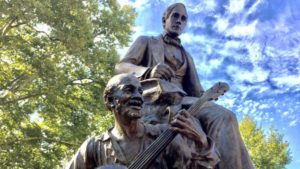
Pittsburgh’s Art Commission will also weigh in on the future of the Stephen Foster statue. (Photo by Colin Deppen/The Incline)
The racial legacy of famed songwriter and Pittsburgh native Stephen Foster has been a topic of debate among scholars and musicians since his death more than a century ago. However, Foster’s gleaming 10-foot-tall statue situated along Forbes Avenue makes the race-based controversy surrounding him that much more apparent.
The sculpture, crafted by artist Giuseppe Moretti, depicts the late lyricist seated on a perch with a notebook as he gazes down, drawing inspiration from the shoeless banjo player — dubbed “Uncle Ned” after one of Foster’s songs — situated at his feet.
For local musician and hip hop activist Paradise Gary, the statue is nothing short of a slap in the face.
“It’s the single most offensive display of public art in Pittsburgh, hands down,” Gray told the Pittsburgh Post-Gazette. “It permanently depicts the Black man at the white man’s feet.”
“[Foster is] doing what the music industry does today,” he continued. “He’s got a slave playing the music, and he’s going to end up with the copyright.”
Joe Wos, a pop culture historian and cartoonist in Pittsburgh, agreed, telling online news site The Incline, “I think the statue is itself racist. I think that while a lot of [Confederate] statues represent a racist ideology, this is the rare case where the statue itself embodies that racism in its portrayal of ‘Uncle Ned.'”
After years of complaints over the statue, city leaders are ready to face the music as they weigh whether to take it down. The Pittsburgh Post-Gazette reported that a task force headed by the University of Pittsburgh has been considering the statue’s future, and that the city’s Art Commission is set to weigh in on the issue, too.
The debate over Foster’s likeness was revived following a violent white nationalist rally in Charlottesville, Va., last weekend sparked by efforts to remove a monument honoring Gen. Robert E. Lee. Since then, cities across the U.S. have hastened their efforts to bring down Confederate statues and others like it that support white supremacy or oppression.
City spokesman Tim McNulty said that while the Charlottesville unrest might have brought issues concerning Foster’s statue back to the forefront for some, “We’ve been working on this for awhile.
“The mayor would like the experts to come up with a recommendation,” McNulty said, adding that the commission would likely discuss the matter within the next month.
Public reaction over the “Camptown Races” composer has been mixed, with some residents imploring Mayor Bill Peduto’s administration to bring down the statue and others calling for it to stay right where it is, The Incline reported. Local woman Jackie Kipilo sees no problem with the statue and told the news site she thinks it should remain standing.
“I’m outraged! Stephen Foster is a great composer and songwriter,” said Kipilo, who lives in Beaver County but works in Pittsburgh. “He wrote hundreds of songs. Now a small group of people are approaching the mayor because they want the statue removed because one percent of his songs were supposedly racist.”
Foster was known for songbook favorites like “Oh, Susanna!” and sing-song compositions for minstrel shows that often used the N-word to reference Black people.
Foster “used the language of the time, which was racist [and] hurtful and damaging,” Deane Root, a music professor at the University of Pittsburgh, told the Pittsburgh Post-Gazette. “There are songs I can’t look at, even though I have to as a historian.”
While some make the argument that Foster’s works helped humanize African-Americans, Root said, “The statue is not the rendering of someone with human characteristics that we hear in his lyrics.” It should be noted that less than two dozen of the songwriter’s 250 compositions feature enslaved Blacks.
The fate of Foster’s statue remains unclear, but city officials are expected to make a decision in the coming months.