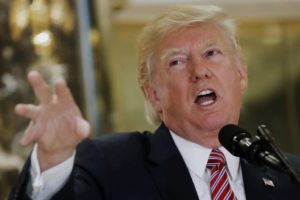
President Donald Trump speaks to the media in the lobby of Trump Tower in New York, Tuesday, Aug. 15, 2017. (AP Photo/Pablo Martinez Monsivais)
After a domestic terrorist used his car to mow down opponents of a white supremacist march on Aug. 12 in Charlottesville, Va., Donald Trump arguably encountered the fiercest opposition to his presidency yet. Trump not only neglected to immediately condemn the attack, which killed demonstrator Heather Heyer, but three days later he said during a news conference that “very fine people” could be found among both the white nationalists marching in Charlottesville. The president’s remarks led to a backlash that has resulted in business leaders and others affiliated with his administration to part ways with him and to the leaders and citizens of countries around the world to criticize Trump’s missteps on Charlottesville.
The fallout has not just been in the United States, but across the globe people have been reacting. The West African nation of Senegal is no exception. Gilles Yabi, founder of a think tank there, recently told BuzzFeed that young Africans are questioning whether the United States is really the shining example of human rights and democracy it has long presented itself to be.
“On a daily basis we see actions and situations that seem to underscore that the United States are not really in a position to give lessons in democracy,” Yabi said.
In South Africa, notoriously home to a system of racial apartheid that mirrored Jim Crow in the United States, an activist only identified as Johannes M. told BuzzFeed, “If there was a surprise, it was the fact that the neo-Nazis and [Ku Klux Klan] can protest and demonstrate.”
The fact that the federal government in the U.S. allows for hate speech shocked the activist likely because in other Western nations, hate speech is banned. Dieudonné M’bala M’bala, a mixed-race comedian, has been jailed and convicted multiple times for using anti-Semitic and hate speech in Belgium and France. In 2011, British fashion designer John Galliano was convicted in France of making anti-Semitic remarks and ordered to pay a hefty fine as a result. Given the penalties people face for hate speech around the world, it comes as a surprise to people outside of the United States that Americans suffer no such repercussions, even with the idea of the U.S. First Amendment protecting unpopular speech.
Didier Kassaï, a cartoonist in the Central African Republic, told BuzzFeed that coverage of Charlottesville and the president’s remarks about the violence there mean that people no longer look at the United States as a model country of sorts.
“Since Trump’s arrival, we no longer see it as a dream country,” he said. “For a country which recently elected a black man to now be in a place reminiscent of an era when the Klu Klux Klan was able to crush African-Americans — it’s like the U.S.’ ray of light has gone out on a global stage.”
Africans aren’t the only ones concerned about the racial discord in the United States. “Harry Potter” author J.K. Rowling, a Brit, joked on Twitter that Trump, unbelievably, had brought the Middle East together as a result of Charlottesville. That’s because both Israel and Iran condemned the president’s remarks on the deadly protests there.
Iran’s Supreme Leader Ayatollah Ali Hosseini Khamenei, reportedly a Holocaust denier, lashed out at Trump over his Charlottesville comments.
“If you are a powerful state, then go manage your own country!” he said. “If you really care, then tackle the insecurities and violence on the streets of Washington, D.C., New York City and Los Angeles! If you really care, go fix racial discrimination and the disastrous violations of human rights for both whites and blacks in your own country! Mind your own business, rather than meddling with other nations’ affairs!” Iran was one of the seven majority-Muslim countries that Trump’s travel ban targeted earlier this year.
In contrast, Trump has described himself as a friend to Israel. But leaders from that country also attacked the president. Israeli politician Tamar Zandberg told CNN, “The stubborn denial of President Trump to denounce neo-Nazis and racists and his flattery of organizations that promote these frightening and unacceptable worldviews … raise serious questions regarding the motivation and the moral consciousness of he who is supposed to be the leader of the free world and the protector of democracy.”
The Charlottesville tragedy has resulted in overwhelming criticism of the U.S. president, but this hardly marks the first time race relations in America have led to international outrage. During the civil rights movement, images of African-Americans being attacked by dogs, fire hosed and otherwise brutalized led other countries to publish headlines about racism in America that proved embarrassing to the federal government. Although Blacks had been enslaved, forced on chain gangs, lynched, raped and more before the 1950s and ‘60s, the invention of television allowed the world to see with its own eyes how the so-called “land of the free” treated its citizens of color. Today, social media adds to the conversation by allowing people all over the world to take in what the general public in the United States thinks of their leader and his actions, or inaction, on race violence.
Well before Charlottesville, the Pew Research Center published its finding in June that just 22 percent of the public in 37 foreign nations had confidence in Donald Trump “to do the right thing when it comes to international affairs.” That compares to 64 percent who believed that President Obama was capable of acting appropriately on foreign affairs. After Charlottesville, there’s little doubt that the world thinks even less of Trump today than it did at the start of the summer, when Pew published its survey results. Just seven months into office, Trump has not only managed to alienate much of the U.S. public but the citizenry of other nations as well. That doesn’t bode well for him or for the country as a whole.


