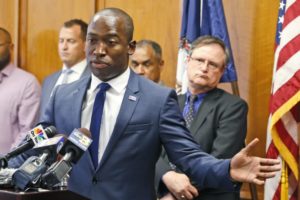
Richmond Mayor Levar Stoney gestures during a news conference at City Hall in Richmond, Va. (AP Photo/Steve Helber, File)
RICHMOND, Va. (AP) — In the wake of a deadly white nationalist rally in Charlottesville, Richmond’s mayor said Wednesday that Virginia’s capital city will consider removing or relocating its prominent Confederate statues.
Mayor Levar Stoney’s announcement Wednesday is a reversal from a position he took earlier this year, when he said he thought the monuments should stay in the former capital of the Confederacy but have context added about what they represent and why they were built.
The mayor joins a growing number of elected officials who have called for Confederate monuments to come down after the violence in Charlottesville, where white supremacists rallied after the city voted to remove of a statue of Gen. Robert E. Lee.
“While we had hoped to use this process to educate Virginians about the history behind these monuments, the events of the last week may have fundamentally changed our ability to do so by revealing their power to serve as a rallying point for division and intolerance and violence,” Stoney said.
Chaos erupted at the Charlottesville rally, which included neo-Nazis, skinheads, Ku Klux Klan members and is believed to be the largest gathering of white supremacists in a decade. Counter-demonstrators and attendees clashed violently in the street, and after authorities ordered the crowd to disperse, a car plowed into a group of marchers, killing a woman and injuring 19 others.
In June, Stoney appointed a commission of historians, experts and community leaders to study either adding context to the statues or building new ones. His Wednesday statement said that commission will begin considering “the removal and/or relocation of some or all” of the statues, effective immediately.
Virginia Gov. Terry McAuliffe issued a statement shortly after Stoney’s, saying he, too, had changed his mind on the issue. McAuliffe, who previously said he didn’t think the statues needed to be removed, said he encourages local governments and the General Assembly to take down the monuments and put them in museums.
“I hope we can all now agree that these symbols are a barrier to progress, inclusion and equality in Virginia and, while the decision may not be mine to make, I believe the path forward is clear,” the governor, a Democrat, said.
Stoney is McAuliffe’s protégé and many expect him to run for governor one day.
The issue has long been debated in Richmond, which served as the capital of the Confederacy during the Civil War and has five soaring Confederate statues along its prestigious Monument Avenue, a boulevard lined with churches and historic mansions. History buffs from around the world come to see the likeness of Confederate Gens. Robert E. Lee, Thomas “Stonewall” Jackson and J.E.B. Stuart; President Jefferson Davis; and oceanographer Matthew Maury.
The monuments were erected decades after the end of the Civil War. The Reconstruction era was over, Jim Crow laws were eroding the rights of Black citizens and an interpretation of the war historians call the Lost Cause was emerging that romanticized the South and de-emphasized slavery.
The monuments are “are a default endorsement of a shameful period in our national and city history,” said Stoney, who is Black and has said he finds the monuments personally insulting.
Phil Wilayto, a community organizer with the group the Virginia Defenders for Freedom, Justice and Equality, had criticized the mayor’s initial position and said Wednesday that he was glad Stoney had reconsidered.
“It will not be an easy discussion, and we expect that regardless of what anyone here in Richmond says, the right-wing supremacist forces will target Richmond because it is the former capital of the Confederacy and has the greatest display of Confederate monuments in the country. We hope the city as a whole can rise to the occasion,” he said.
B. Frank Earnest, heritage defense coordinator for the Sons of Confederate Veterans, said that the monuments should stay and that the mayor should have “let things cool down.”
He also insisted that removing the monuments would violate a state law on war memorials that says they can’t be removed, damaged or defaced.
That’s an issue that will likely play out in court soon.
In Charlottesville, a coalition of residents and the Sons of Confederate Veterans sued the city over its decision to remove the Lee statue that sparked the nationalist rally. They said, in part, that the decision violates the war memorial law.
The city has argued the law doesn’t apply because it was not in existence at the time the statue was erected.
A hearing in the case is scheduled later this month.