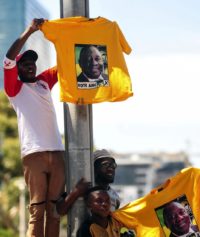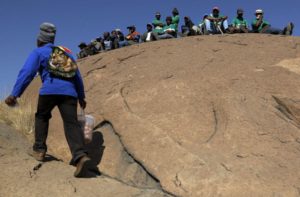
Mine workers sit on a hill during the commemoration ceremonies in Marikana, South Africa. (AP Photo/Themba Hadebe)
JOHANNESBURG (AP) — Five years after South African police shot dead 34 striking mine workers, recalling police brutality under apartheid, rights groups say no one has been prosecuted and miners’ living conditions are as “squalid” as ever.
On Aug. 16, 2012, police opened fire on workers demanding wage increases and better living conditions at a platinum mine operated by Lonmin Plc in Marikana. At least 70 were injured.
The shootings shocked South Africa, where mining is a major pillar of the economy.
Despite the outrage, no prosecutions have been made in connection with the killings, Amnesty International said in a report released this week to mark the anniversary. That’s despite President Jacob Zuma’s pledge last year that criminal charges would be brought against several senior police officers.
“The tragedy of the Marikana killings is compounded by the shocking fact that no one responsible for the bloodshed has yet been held accountable,” Shehnilla Mohamed, executive director of Amnesty International South Africa, said in a statement.
On Wednesday, rights groups planned to picket outside Lonmin’s headquarters and the South African High Commission, both in London, to commemorate the five-year anniversary.
And thousands of people gathered at the site of the shootings to mark the anniversary.
While more than 70 police officers were identified by the government’s police watchdog for possible prosecution by the National Prosecuting Authority in May, no action has been taken, Amnesty said.
The prosecuting authority is still evaluating the evidence, the body’s spokesman, Luvuyo Mfaku, told The Associated Press. “Once the process is finalized a decision whether or not to prosecute any person(s) in respect of the matter will be made.” The police watchdog did not immediately respond to requests for comment.
Some Marikana mine workers and their family members say the wider community’s living conditions have not sufficiently improved since 2012, a prevalent problem in many South African mining towns.
“After five years, there is nothing happening in Marikana,” said Thumeka Magwangqana, a founder of the Sikhala Sonke Women’s Organization, an activist group.
Magwangqana lives in an informal settlement near the mine with her daughter, a former Lomnin worker, and is featured in the 2017 documentary “Strike A Rock” about the group.
“We are fighting for good living conditions,” Magwangqana said. “There are no roads, there is no running water. But 200 meters away from our homes, Lonmin has electricity, water and tar roads.”
Lonmin says it has built more than 7,600 houses for its employees at the Marikana mine but acknowledges about 11,500 employees may still require housing. It attributes the slow progress to “economic conditions and the subsequent collapse of platinum prices,” which the company says have dropped by 50 percent in the past two years.
In the aftermath of the shooting, Lonmin also offered jobs to family members of each mine worker who was killed, and established a trust to help deceased employees and contractors’ children with their education.
“We have accomplished a great deal in a difficult environment and are committed to finishing the job as soon as possible,” the company said in a statement. “Our employees’ safety and welfare are our first priority.”