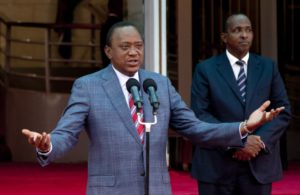
President Uhuru Kenyatta was declare the winner of the election, though is opponent labeled the vote fraudulent. (AP Photo/ Sayyid Abdul Azim)
NAIROBI, Kenya (AP) — Kenyan President Uhuru Kenyatta urged peace and lawful demonstrations Monday, as the capital appeared to resume ordinary life following last week’s disputed elections.
Many Nairobi residents returned to work on Monday despite a call by opposition leader Raila Odinga to stay at home to protest the elections, in which Kenyatta was declared the winner and which the opposition dismiss as fraudulent.
Kenyans have the right to protest but must do so peacefully, said Kenyatta, who previously appealed for unity after his victory was announced.
“As a government, we will not allow loss of life, destruction of property and looting,” he said, speaking to journalists at his Harambee House offices in Nairobi.
Some street stalls were closed, but others opened in the Nairobi slum of Mathare, an opposition stronghold where police battled rioters following the Aug. 8 election that Odinga said was fraudulent. The Kenyan election commission says its voting and counting process was not rigged and international observers have praised Kenya’s handling of the election.
Minibus taxi drivers shouted for business from potential passengers in a busy intersection inside Mathare as residents carried vegetables, chickens and went about their business. There was a small protest in Nairobi’s Kibera slum, another scene of recent clashes.
Life is returning to normal and residents of the capital are “safe and secure,” said Japheth Koome, Nairobi’s police chief.
Even so, there was tension overnight as young men with machetes moved around some areas.
Odinga has said he will announce his “next step” on Tuesday as the government urges people to resume their routines, nearly a week after the election in the East African commercial hub of 45 million people. While he has remained defiant and is sticking to his position that the election was rigged, some sectors of society are urging him to acknowledge defeat so that Kenya can stabilize.
“I must go out to hustle for myself so I can pay rent, so I can feed myself,” said Isack Avonga, a Nairobi resident who disregarded Odinga’s call for a boycott.
Police have fatally shot 24 people in election violence since the vote, according to the state-funded Kenya National Commission on Human Rights, which monitors government institutions. Police have denied they killed that many people, saying they shot some criminals who attacked them and that none of the protests were peaceful.