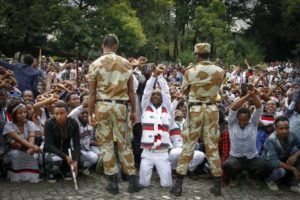
Ethiopian soldiers try to stop protesters in Bishoftu during a declared state of emergency in the Oromia region of Ethiopia. (AP Photo, File)
JOHANNESBURG (AP) — Ethiopia’s government on Friday lifted a state of emergency imposed in October after hundreds of people were killed in anti-government protests demanding wider political freedoms. It was some of the country’s worst violence since the ruling party came to power in 1991.
Lawmakers in the East African nation voted to end the emergency law that restricted a number of rights and led to the arrests of more than 21,000 people. It also hurt one of Africa’s fastest-growing economies.
More than 600 people were killed in nearly a year of protests that first ignited in the Oromia region and spread into the Amhara region and the capital, Addis Ababa. Demands included an end to arbitrary arrests and respect for regional autonomy.
The state of emergency was imposed after a deadly stampede at a religious celebration in October as police confronted protesters. The emergency law was extended in March.
“We have been able to deal with armed terrorists, anti-peace elements and troublemakers,” Defense Minister Siraj Fegessa said, adding that the government was now able to deal with “a few” remaining security threats.
The minister said more than 8,000 people are still behind bars and are being prosecuted for crimes they are accused of committing during the unrest.
Rights groups have claimed that many people were beaten and subjected to arbitrary detentions under the emergency law. The government has maintained that those arrested by mistake were released and those who unwillingly took part in the unrest were released after what it described as “trainings.”
Restrictions under the state of emergency included arbitrary arrests without court orders; limits on radio, television and theater; and dawn-to-dusk prohibitions on unauthorized movements around infrastructure facilities and factories.