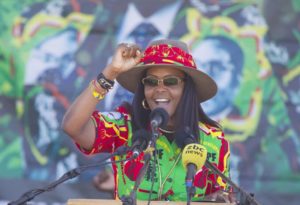
Zimbabwe’s First Lady Grace Mugabe greets supporters at a rally in Lupane about 170 Kilometres north of Bulawayo, Zimbabwe. (AP Photo/Tsvangirayi Mukwazhi)
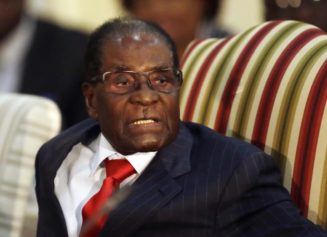
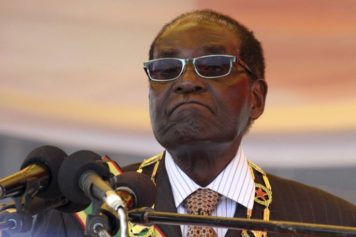
HARARE, Zimbabwe (AP) — Zimbabwe’s first lady on Thursday publicly urged her 93-year-old husband to name a successor, wading into a subject that President Robert Mugabe has regarded as taboo.
Grace Mugabe, whose political influence has been growing, previously said the world’s oldest head of state could rule from the grave. “If God decides to take him, then we would rather field him as a corpse” in the 2018 election, she said early this year.
But in comments shown by state broadcaster ZBC, the first lady on Thursday said she had been arguing with him about naming a successor: “He says no, no, no.”
With her husband in attendance, she told members of the ruling ZANU-PF party women’s league: “I am asking him now in front of you … You, president, don’t be afraid. Tell us your choice. Which horse should we back? Because we respect him, his word will be final.” The audience cheered, though the president’s response was not immediately clear.
The president, who has led the southern African nation since 1980, already has started campaigning for next year’s vote. He has repeatedly said he will not choose a successor.
The 52-year-old Grace Mugabe, who heads the ZANU-PF women’s league, has become increasingly powerful. Her decisions have carried more weight at times than those of the country’s vice presidents, and she has been headlining her own political rallies since 2014.
While she is seen as a potential successor to her husband, she has sent mixed signals. She has said she has no problem becoming president but on other occasions has said she has no such ambitions.
On Thursday, the first lady used a biblical analogy of a son who organized a feast to crown himself because his father was close to death. She said naming a successor “has been the trend in other countries,” ZBC reported.
Some analysts have suggested that Robert Mugabe, who visibly struggles to walk these days, could call an early election.
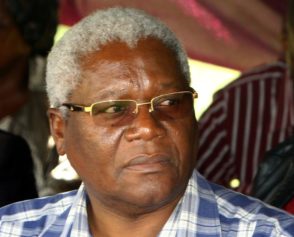
His party’s secretary for administration, Ignatius Chombo, last month said Mugabe could call an election in February or March. He can only do that if Parliament, where his party holds a majority, chooses to dissolve itself.
The constitution stipulates the earliest date Mugabe can call an election is in July 2018.
Fights to succeed Mugabe have intensified in recent months, with Cabinet ministers and military generals trading insults on mainstream and social media over the issue.
Mugabe and his wife have warned against senior party officials anointing themselves as successors. A Cabinet minister, Jonathan Moyo, has repeatedly tweeted that Vice President Emmerson Mnangagwa, a close Mugabe ally since the 1970s war of liberation from white minority rule, has done so. Mnangagwa has denied the claim, saying he is loyal to the president.
Mnangagwa leads one of the two factions setting themselves up to succeed Mugabe. The first lady is associated with a youthful faction called G-40, or Generation 40.