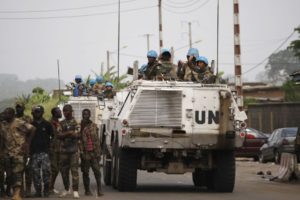
United Nations peacekeeping soldiers. (AP Photo/Rebecca Blackwell, File)
YEI, South Sudan (AP) — The United Nations says it is considering opening a peacekeeping base in South Sudan’s troubled Yei region, which has “gone through a nightmare” in recent months amid warnings of ethnic violence. It would be the U.N.’s first such expansion since civil war began in 2013.
“I can see the prosperity that was once here,” the peacekeeping mission’s chief, David Shearer, told residents on his first visit. But stories of rape, killings and abductions are common in what has become one of South Sudan’s most volatile cities.
The U.N. warned of growing ethnic violence after bodies with bound hands were found in Yei late last year. In May, a U.N. report said pro-government forces killed 114 civilians in Yei between July and January, brutally raping girls and women in front of their families.
Three months ago, 37-year-old Suzanne Minala was abducted by rebels on the edge of Yei and held for 30 days. Raped and beaten nightly, the mother of two said she returned home to find four of her relatives had been killed in her garden. She suspects it was government soldiers.
“The government doesn’t want to hear about crimes because they kill people,” Minala told The Associated Press, rubbing a scar on her wrist where she had been bound.
Since the fighting reached Yei a year ago, 70 percent of the population has fled. Remaining residents say it’s like living in a prison. The city is under government control but surrounded by opposition forces, and both have restricted access to food and aid.
“We can’t go out,” one community leader, Ali Ecsss, told the AP. Residents said some who go beyond a few miles outside the city never return.
“It is a cruel tragedy of this war that South Sudan’s breadbasket, a region that a year ago could feed millions, has turned into treacherous killing fields,” said Joanne Mariner, Amnesty International’s senior crisis response adviser.
The U.N. said a peacekeeping base will come to Yei only if local movements are unrestricted. At a meeting last week with humanitarian workers, Yei’s governor said he would open the roads. Aid workers and the U.N. have repeatedly noted that despite such promises by government officials, restrictions remain in many parts of the country.
“Humanitarians will have to work with the country’s national security service in order to ensure their safety,” said Goodwin Ale, a field officer with the interior ministry.
The U.N. has several peacekeeping bases in South Sudan, where tens of thousands have been killed in the civil war. More than 200,000 civilians still shelter in the bases after the U.N. took the unusual decision to open their doors shortly after the conflict began.
Nearly two million other people have fled the country, creating the world’s fastest-growing refugee crisis.