
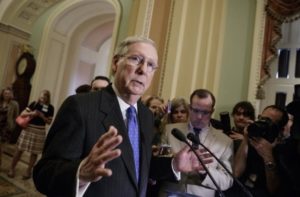
Senate Majority Leader Mitch McConnell
WASHINGTON (AP) — The number of U.S. adults without health insurance has grown by some 2 million this year, according to a major new survey that finds recent coverage gains beginning to erode.
The new numbers highlight what’s at stake as Congress returns to an unresolved debate over Republican proposals to roll back much of former President Barack Obama’s health care law.
The Gallup-Sharecare Well-Being Index, published Monday, found that the uninsured rate among U.S. adults was 11.7 percent in the second three months of this year, compared with a record low of 10.9 percent at the end of last year. Though small, the change was statistically significant, survey analysts noted.
While “Obamacare” has remained politically divisive, it had helped drive the uninsured rate to historic lows as some 20 million people gained coverage.
Senate Majority Leader Mitch McConnell, R-Ky., plans to check vital signs on his GOP bill as senators trickle back to Washington from a July 4 break that many spent listening to constituents vent about health care.
McConnell is seen as a master legislative strategist, but there’s no sign he’s secured enough votes to pass a bill. He can only afford to lose two out of 52 Republican senators.
The Congressional Budget Office has estimated that at least 22 million more people would become uninsured under Republican legislation.
McConnell has been considering easing some of the bill’s Medicaid cuts, beefing up health care tax credits to help people buy private insurance and adding billions of dollars to counter the opioid epidemic. That might comfort GOP moderates. To placate conservatives, McConnell is weighing demands to make it easier for insurers to offer skimpier policies.
He’s also admonished fellow Republicans that they may find themselves negotiating with Democratic leader Sen. Chuck Schumer of New York if they don’t close ranks. In that case, McConnell said he’d aim for a limited package propping up troubled insurance markets around the country.
The Gallup-Sharecare survey serves as a kind of early indicator, publishing several months before the nimblest government surveys. The most recent government report found that progress reducing the number of uninsured stalled in 2016, after five consecutive years of coverage gains under Obama.
Peering at this year, Gallup-Sharecare found an erosion of progress, with the number of uninsured edging up again. It estimated nearly 2 million dropped out of coverage.
The losses were concentrated among younger adults and people buying their own health insurance policies, the survey found.
That may be a reflection of rising premiums and dwindling choices in the insurance markets created under Obama. “Rising insurance premiums could be causing some Americans to forgo insurance, especially those who fail to qualify for federal subsidies,” said Gallup’s analysis of the survey.
Also, President Donald Trump has branded his predecessor’s leading domestic achievement a “disaster” while pursuing its repeal. Some insurers say Trump administration actions are contributing to double-digit premium increases for next year.
“Uncertainty surrounding the health care law also may be driving the increase,” the analysis added. The president’s “executive order permitting agencies to waive or delay provisions that ‘impose a fiscal burden’ on individuals, as well as the prospect of a new health care law, may be causing consumers to question whether the penalty for not having insurance will be enforced.”
Gallup-Sharecare found that the uninsured rate rose by 1.9 percentage points among adults aged 18-25 since the end of last year, and 1.5 points among those aged 26-34.
Participation by young adults is considered vital for keeping health insurance premiums in check. But young adults also are likely to enjoy good health and may not recognize value in having coverage.
The Gallup-Sharecare survey is an ongoing effort based on interviews with about 500 people a day. It was previously called the Gallup-Healthways Well-Being Index.
Results are based on telephone interviews conducted April 1-June 30, with a random sample of 45,087 adults, aged 18 and older, living in all 50 U.S. states and Washington, D.C. The margin of error is plus or minus 1 percentage point.


