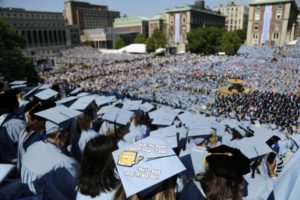
Graduating students fill the Columbia University campus during a graduation ceremony in New York. (AP Photo/Seth Wenig, File)
Having college debt disappear is something many student loan holders can only dream of. But it’s possible for some of the 44 million people in the U.S. with education loans.
Through the Public Service Loan Forgiveness Program, people with federal student loans can get their loans erased tax-free if they first make loan payments for 10 years while working for the government or a nonprofit.
That’s the gist of it, at least. The program rules are more nuanced. Unaware of the complexities, many loan holders inadvertently make decisions that render them ineligible. Only a few hundred people are on track to get forgiveness this fall — the soonest borrowers can receive forgiveness through the program — according to data the U.S. Department of Education presented to financial aid professionals last year.
Borrowers can look out for these PSLF missteps to ensure they stay on track for loan forgiveness.
1. HAVING THE WRONG TYPE OF LOANS
Borrowers’ loans must be in the federal Direct Loan Program to qualify for PSLF, which is not the case for nearly 19 million people — or 44 percent of federal student loan borrowers — who have loans in other federal programs, according to 2017 Department of Education data. Those borrowers’ nondirect loans are ineligible for PSLF unless they first join the Direct Loan Program by consolidating their debt.
And, in that case, payments won’t count toward PSLF until those borrowers consolidate into direct loans.
2. MISUNDERSTANDING ‘QUALIFYING PAYMENTS’
To be eligible, borrowers must work full time while making 120 qualifying monthly payments, meaning the payments were made:
—After Oct. 1, 2007
—Through a qualifying repayment plan (generally an income-driven plan )
—For the full payment amount due
—No later than 15 days after the due date
—While the borrower was employed full time by a qualifying organization
To benefit from PSLF, borrowers must make at least some payments on an income-driven plan, a federal repayment plan that caps borrowers’ payments at a percentage of their income. If federal loan borrowers stay on the standard 10-year plan, they’ll fully repay their loans by the time they qualify for forgiveness.
Only one qualifying payment counts per month, which means paying extra each billing cycle won’t help borrowers achieve forgiveness faster. The payments don’t need to be consecutive. They don’t count if they’re made while the borrower is in school, during the loan grace period or while the loan is in deferment or forbearance.
3. WORKING FOR THE WRONG TYPE OF EMPLOYER
Federal direct loan holders who work full time for the government, a 501(c)(3) nonprofit or an organization providing a qualifying public service may be eligible for PSLF, regardless of their job title. For instance, a full-time janitor at a public school could qualify.
“It’s not about what you do,” says Betsy Mayotte, director of consumer outreach and compliance for the Center for Consumer Advocacy at the Boston-based nonprofit American Student Assistance. “It’s about who you work for.”
Borrowers who are on the job hunt and considering PSLF should check that the employer qualifies before accepting an offer.
Until borrowers have made their 120 qualifying payments, they should submit employment certification forms to the Department of Education to confirm that their work qualifies.
4. FALLING FOR FRAUDULENT PROMISES OF FORGIVENESS
Dozens of companies use false claims to con borrowers, a NerdWallet investigation found. They promise to reduce or eliminate loans and charge high fees to enroll people in free federal programs.
For instance, “Obama student loan forgiveness” is a popular scam. The term gets more than 18,000 online searches per month, but no such program exists.
Beware of companies that collect high upfront fees or charge recurring monthly amounts, two signs that an offer is likely too good to be true.
THE FUTURE OF PUBLIC SERVICE LOAN FORGIVENESS
Education Secretary Betsy DeVos has proposed cutting PSLF, which started in 2007 during the Bush administration. Critics of the program argue it’s too expensive and disproportionately benefits graduate and professional school students, many of whom have six-figure debt loads.
If the proposed cuts go into effect, loans made before July 1, 2018, would be still be eligible for the program.