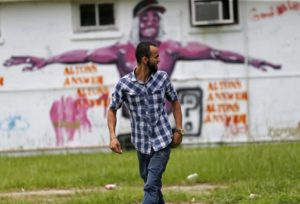
Abdullah Muflahi walks outside his Triple S Food Mart in front of a mural of Alton Sterling in Baton Rouge, La. (AP Photo/Gerald Herbert)
BATON ROUGE, La. (AP) — A year ago, Abdullah Muflahi rushed outside his convenience store, whipped out his cellphone and began taping moments before a white police officer shot and killed a Black man in the parking lot.
Muflahi’s video fueled nightly protests that turned his friend, 37-year-old Alton Sterling, into another symbol of outrage over deadly police shootings. The July 5 shooting also transformed Muflahi’s store into a hub for protesters and a canvas for their grief and anger.
Visitors routinely stop by the Triple S Food Mart to photograph an iconic mural of Sterling’s smiling face on its aluminum siding. A makeshift memorial — now reduced to soggy stuffed animals and withered flowers — still stands on the table where Sterling once sold homemade CDs outside.
Little has changed in this poverty-stricken neighborhood since the shooting — a frustrating fact of life for residents and business owners who had hoped a national spotlight on their problems could erode racial divisions and improve police relations in Louisiana’s capital.
“It’s overlooked. It’s not much that the city does around here,” Muflahi said. “There are things that the city could fix and help make it better, but nobody looks at it like that.”
Muflahi, a 29-year-old native of Yemen, mourns Sterling as the friend who introduced himself as “Big Boy” and welcomed him after he moved here from Detroit and bought his store in 2010.
“He’s the one who actually showed me around and looked out for me,” Muflahi said.
The shooting strengthened Muflahi’s bond with neighbors who protested outside the store after Sterling’s death. But Muflahi said store revenue also plummeted and has been slow to rebound.
“A lot of people were scared to come up here,” he said. “A lot of my regulars, the older people, I haven’t seen them.”
A federal investigation found the confrontation with the two white officers, Blane Salamoni and Howie Lake II, lasted less than 90 seconds.
The officers approached Sterling about a call that a Black man selling CDs had threatened someone with a gun. They struggled with Sterling after he didn’t comply with commands to put his hands on the hood of a car, then wrestled him down after Lake shocked him with a Taser, federal authorities said.
Investigators found that Salamoni shot Sterling three times after saying Sterling was reaching for a gun in his pocket, and fired three more shots into Sterling’s back when he began to sit up. A loaded revolver was recovered from Sterling’s pocket.
In May, the Justice Department announced it would not file criminal charges against either officer. Louisiana’s attorney general is reviewing whether any state charges are warranted. The officers remain on paid leave.
Donna Harris, a 41-year-old nurse, lives nearby and joined the protests. A year later, she’s still waiting for some reason to be optimistic.
“Nothing got better. Nothing changed,” she said. “They haven’t even given us justice for Alton.”
State Rep. Ted James, a Baton Rouge Democrat and native of the area, said he sees some progress. But he also sees enduring racial divisions and acknowledges that predominantly Black north Baton Rouge — where Sterling lived and died — still suffers from a longstanding “lack of investment.”
“That type of long-term change is going to take time,” he said. “Things are happening. I recognize it’s not happening as fast as folks would like to see it.”
At a salon across the street from the Triple S Food Mart, hair stylist Ronnie Horton said he believes politicians have shortchanged the neighborhood for years.
“You go across on the other side of town, it’s beautiful,” he said. “It’s not up here.”
After Sterling’s death, James and other Black lawmakers secured legislation — since signed into law — to strengthen police training requirements and prevent disgraced officers from keeping their jobs or getting new ones elsewhere. “A lot of those ideas came from concerns from people in the community,” James said.
Arthur “Silky Slim” Reed, an activist who orchestrated the release of the first cellphone video after Sterling’s shooting, said he believes police officers will ignore policy changes unless they face consequences for violating them.
“There was a lot of talk about police reform, bringing the community together with the police. And I think the gap is widening,” he said.
Muflahi sued the city, claiming investigators illegally detained him for hours in the back of a police car. That suit is still pending. He said many residents still distrust the police department — some now more than ever — and can’t fathom why the shooting is still under investigation a year later.
“I thought we would have gotten somewhere,” Muflahi said. “The whole city, the family, everybody is just waiting to see what’s going on.”