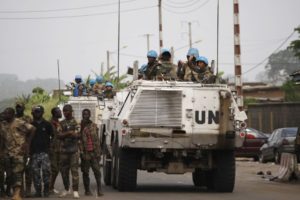
United Nations soldiers wave as they drive past forces loyal to Alassane Ouattara. (AP Photo/Rebecca Blackwell, File)
UNITED NATIONS (AP) — The General Assembly on Friday agreed to a significant cut in the budget for the U.N.’s far-flung peacekeeping missions, a reduction that the Trump administration fought hard to achieve though it wanted an even larger decrease.
After lengthy and heated negotiations, the assembly’s powerful budget committee agreed to a $7.3 billion budget for 14 peacekeeping missions for the year starting July 1, a $570 million cut from the current budget of $7.87 billion.
The 193-member world body voted by consensus to approve $6.8 billion. It also agreed to an additional $500 million for two missions that are in the throes of downsizing — the joint U.N.-African Union mission in Sudan’s troubled western Darfur region and the U.N. peacekeeping mission in Haiti.
U.S. Ambassador Nikki Haley said after the budget committee’s agreement early Thursday: “Just five months into our time here, we’ve already been able to cut over half a billion dollars from the U.N. peacekeeping budget and we’re only getting started.”
The United States has been reviewing every peacekeeping mission as its mandate comes up for renewal.
The U.N. has also been carrying out its own reviews. Those led to the closing on Friday of the peacekeeping mission in Ivory Coast, which was sent to the West African nation in 2004 to implement a cease-fire after a civil war. The peacekeeping mission in Liberia, established in 2003 to support implementation of a cease-fire agreement, is wrapping up its operations next year.
U.N. peacekeepers sent to Haiti in 2004 to help normalize a country in chaos after political upheaval will leave in October. The Security Council created a small follow-on peacekeeping mission for an initial period of six months comprising 1,275 police officers who will continue training Haiti’s national police force.
The latest cuts were in the Darfur mission, known as UNAMID, whose current budget is over $1 billion annually. The council voted Thursday to reduce the number of peacekeepers by 44 percent and the number of international police by about 27 percent.
When negotiations in the General Assembly budget committee began, the United Nations was seeking to increase the peacekeeping budget to near $8 billion, while the U.S. wanted to cut it to just below $7 billion.
Italy’s U.N. ambassador, Sebastiano Cardi, told reporters the $7.3 billion agreement “was absolutely the proposal by the European Union, so it’s been a satisfactory solution.” He said the cuts didn’t jeopardize the operation of the U.N. missions and were going “to make peacekeeping better.”
U.N. spokesman Stephane Dujarric said, “The overall level is meaningfully smaller than what we had last year, but we will make every effort to ensure that the mandates are implemented.
“We cannot overstate the value of peacekeeping to achieve peace and stability,” he said. “It remains the most cost-effective instrument at the disposal of the international community to prevent conflicts and foster conditions for lasting peace.”