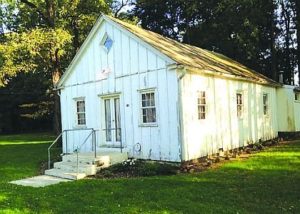
A historic marker will be erected at the remains of a Civil War-era Black community known as Colemantown, which includes a meetinghouse, in Mount Laurel, N.J. (Photo/Cherri Gregg via South New Jersey Journal)
A Black community in southern New Jersey that once served as a stop on the Underground Railroad for enslaved Africans on their journey to freedom will receive past-due recognition when it gets a historic marker on Saturday, June 17.
Only Jacob’s Chapel AME Church, its cemetery and meetinghouse remain of the 19th-century Black community known as Colemantown in Mount Laurel, N.J., a suburb of Philadelphia, according to the Courier-Post.
A marker designating the community on state and national registers of historic places will be unveiled at 11:30 a.m. Saturday at 318 Elbo Lane between the church and meetinghouse, the newspaper reported.
A celebration will continue until 4 p.m. with food, music and a historic theater reenactment to highlight the community’s place in history as part of Juneteenth, the nationwide commemoration of the announcement of the abolition of slavery following the Civil War in 1865.
The church, the Southern Burlington County Branch of the NAACP, the Historic Underground Railroad Museum of Burlington County and the Dr. James Still Historic Office Site and Education Center, which honors the life of a local Black doctor, all are co-hosting the event.
Colemantown is but one example of once-thriving Black communities around the country that have been lost to history.
The Rev. Terrell Persons, pastor of the church that has largely remained functioning since 1865, told the newspaper that the Jacobs Chapel AME Colemantown Foundation secured a grant from the Garden State Historic Trust to purchase the marker.
The meetinghouse, which is in need of repairs, served as the center of Colemantown, one of south New Jersey’s early African-American communities, according to The Mt. Laurel Sun.
“It is on the national register of historic places here in our township, and it’s truly, in my opinion, a gem to the township,” Julie Williamson, an attorney representing Jacob’s Chapel, told the newspaper following a November council meeting where a marker was approved solely for the church.
“Its history is very rich.”