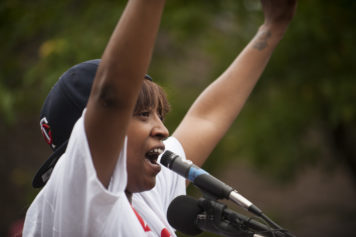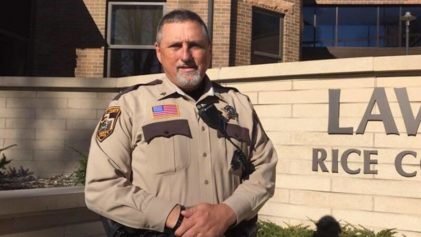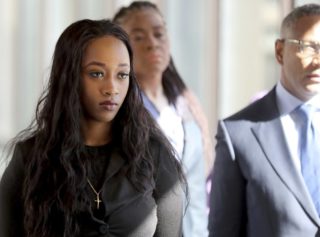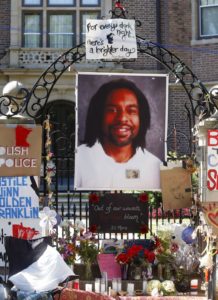
Closing arguments began Monday, June 12, 2017, in Jeronimo Yanez’s manslaughter trial in the fatal shooting of Philando Castile. (AP Photo/Jim Mone, File)
ST. PAUL, Minn. (AP) — A prosecutor on Monday urged a jury to convict a Minnesota police officer of manslaughter for shooting a Black motorist during a traffic stop, arguing that the officer never saw the man’s gun and could have stopped short of shooting even if he had.
Prosecutor Jeff Paulsen highlighted autopsy evidence in his closing argument in the trial of officer Jeronimo Yanez, who fatally shot Philando Castile just seconds after pulling his car over last July in a St. Paul suburb.
Castile had informed Yanez he was carrying a gun. He had a permit to do so. The 32-year-old school cafeteria worker was one in a string of Black men to die at the hands of police in recent years, and his death drew additional attention because his girlfriend, Diamond Reynolds, streamed the gruesome aftermath on Facebook.
Yanez, 29, testified Friday that he clearly saw Castile’s gun and that Castile disregarded his commands not to pull it out. The officer said he fired because he feared for his life.
Paulsen reminded the jury of a bullet wound to what would have been Castile’s trigger finger — and that there was no corresponding bullet damage nor wounds in the area of Castile’s right shorts pocket, where he carried his gun. He also cited testimony from first responders of Castile’s gun falling out of his pocket as he was loaded onto a backboard.
And he asked the jury to consider what might have happened if Yanez, when told of the gun, had simply stepped back a few feet to better assess the situation. The officer might have heard Castile say he was just trying to get his wallet, Paulsen said.
“If he had done that, everybody would have gone home safely that night,” the prosecutor said. He also alluded to testimony from defense witnesses who portrayed Yanez as a good and honest man.
“The victim in this case was a good man, too,” Paulsen said, and referred to Castile’s job at an elementary school. “The kids loved him, and he was a role model to them. And now they’ve been deprived of that role model.”
Defense attorneys have argued that Yanez’s actions were reasonable. They also argued that Castile had smoked marijuana before the traffic stop and was stoned, which influenced his actions. They were to present their closing argument later Monday.
Yanez, who is Latino, is charged with second-degree manslaughter, punishable by up to 10 years in prison, and with two lesser counts of endangering the safety of Reynolds and her daughter for firing his gun into the car near them.
Conviction on the manslaughter charge requires the jury to find Yanez guilty of “culpable negligence,” which the judge described in jury instructions as gross negligence with an element of recklessness.
The 15-member jury includes two Black people. The rest are white. None is Latino. It’s not clear which three members are the alternates, who will be dismissed after closing arguments.
Yanez testified Friday that he stopped Castile in the St. Paul suburb of Falcon Heights because he thought Castile looked like one of two men who had robbed a nearby convenience store a few days earlier. A faulty brake light gave the officer sufficient reason to pull him over, several experts testified.
Squad car video played repeatedly for the jury last week shows the situation escalated quickly, with Yanez shooting Castile just seconds after the driver volunteered, “Sir, I have to tell you, I do have a firearm on me.” Five of the officer’s seven shots struck Castile.
After he shot Castile, Yanez is heard on the squad car video telling a supervisor variously that he didn’t know where Castile’s gun was, then that he told Castile to get his hand off it. Yanez testified Friday that he meant that he didn’t know where the gun was “up until I saw it in his right thigh area.”
Paulsen reminded the jury of the recorded statements on Monday, saying they should consider them accurate.