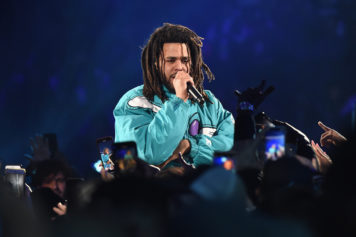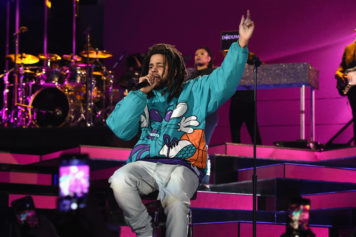
J. Cole and his wife recently welcomed a child. (Tim Mosenfelder /Getty Images)
J. Cole has moved past beefing with fellow rappers.
The man born Jermaine Cole admitted he used to engage with the music-based feuds and his 2016 single “False Prophets” spurred fans to speculate he was taking shots at several rappers, including Kanye West, Drake, Lil’ Yachy and Wale.
“That speaks to the state of us as a people,” Cole said to The New York Times ahead of the premiere of his HBO documentary “4 Your Eyez Only” Sunday, April 16. “For so long, my mind state was, ‘I have to show how much better than the next man I am through these bars. Who’s the best? Let me prove it.’ And it’s just like, ‘Damn, I’m really feeding into a cycle of keeping Black people down, I’m really feeding into that.'”
Wale dropped “Groundhog Day” in response to Cole’s December release of “False Prophets,” but the pair indicated they were on good terms when they appeared at the North Carolina State vs. Boston University basketball game hours after Wale’s rebuttal.
Cole, who recently welcomed a baby with wife Melissa Heholt, retreated from the spotlight after he realized the attention and material things weren’t something he was interested in. He moved to Raleigh, N.C., two years ago and decided to make music that was meaningful to him.
“The other side, it’s what we grow up believing that we need and want. It’s everybody’s dream,” he said of fame. “Who doesn’t want the pick of the litter on this, that and the third? Money, women, cars. And beyond all of that — which I really wasn’t into — praise. It’s addictive. To recognize it, it was the first step.
“Any reasonable person would be ecstatic,” he said of his high-recognition. “I didn’t have that feeling.”
Cole’s personal input into his career extends to his HBO documentary, which aired Saturday, April 15. Directed by Cole and Scott Lazer, it featured a scene between two Black men debating about the role the government plays in Black oppression.
“I felt like it would be mad powerful for Black people to see Black people talking to each other,” Cole said. “And you see a rapper who’s considered one of the biggest in the game, just listening. These are people that never get to be heard, by the world or even by each other.”