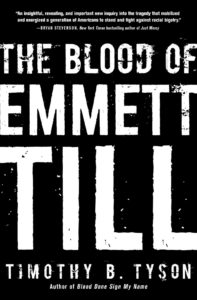
Timothy B. Tyson’s The Blood of Emmett Till
“The spectacle surrounding Emmett Till’s death” as described by historian and Duke University professor Timothy B. Tyson, was “television’s first real ‘media circus.'” In “The Blood of Emmett Till” (2017), Tyson details how the infamous 1955 torture and murder of a 14-year-old Black child generated an astounding quantity of television and press coverage, which showcased the barbarism of white supremacy and ignited a generation of freedom fighters.
The primary talking point for the new release is direct testimony from Carolyn Bryant Donham, the white woman who accused Till of harassing her and led to his murder by her husband and brother-in-law. The narrative opens with Donham, depicted by Tyson as the “fairest flower of Southern womanhood,” serving coffee and pound cake while affirming her role as the “mouthpiece of a monstrous lie.” From a 1955 Mississippi witness stand, Donham called Till “a n—r man” before falsely charging that he sexually accosted her. Now, more than 60 years after the ghoulish murder, Tyson told The New York Times, “The circumstances under which she told the story were coercive.” Tyson characterizes Donham, 82, as hauling a “great burden of guilt and sorrow” for her part in Till’s killing.
Her admission of lying both during the 1955 murder trial and repeatedly to FBI officials in 2004 following the case being re-opened carries no chance of Donham being prosecuted for any crime. The penalty for perjury carries a maximum five-year sentence and the statute of limitations has long since expired.
However, murder has no statute of limitations. And some, like filmmaker and civil rights researcher Keith Beauchamp, believe Donham is criminally culpable for Till’s death. Beauchamp insists that in this case, no one’s burden has been heavier than that of his friend, Mamie Till Mobley. Dedicating a half-century to the memory of her son, Mobley asked former president Dwight Eisenhower to help her see “justice … meted out to all persons involved in the beastly lynching” of her child. Beauchamp worked strategically with Mobley for eight-and-a-half years to produce “The Untold Story of Emmett Louis Till.” His work inspired the Department of Justice to re-open the Till murder case in 2004 as well as other unsolved civil rights crimes; Beauchamp was invited to liaison with the DOJ investigation.
Beauchamp encourages everyone to research the DOJ’s 2006 report of Dunham’s possible involvement in Till’s death. He told Atlanta Black Star his research uncovered “Bryant and J.W. Milan, the two white men who were acquitted of Till’s murder but subsequently confessed to the crime, allegedly relied on Donham to identify Till, possibly making her an accessory to the crime. After the Justice Department’s investigation they declined to pursue an indictment against Donham fearing a lack of new evidence and whiter jury pool. Instead in 2007 they supported the impaneling a state grand jury in Greenwood Mississippi, on a manslaughter charge in connection to the murder. A majority Black grand jury voted not to indict because of lack of evidence, effectively ending the legal proceedings in the Emmett Till case. Without new evidence, none of Till’s killers will be held accountable.
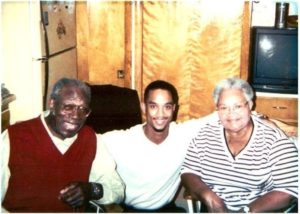
Gene Mobley and Mamie Till Mobley in conversation with Keith Beauchamp (center). 1996
Although Beauchamp esteems Tyson’s historical scholarship, he questions why Tyson concealed Donham’s confession for so many years. Tyson interviewed her in 2008 — a year after she dodged a manslaughter indictment for Till’s death. As murder has no statute of limitations, Beauchamp contends Tyson is “obstructing justice” and withholding “information related to an open murder case.” Conversing with Atlanta Black Star, Beauchamp asked, “Why didn’t [Tyson] reach out to the [Till] family?” Beachamp described Till’s relatives as “blindsided” and “angry” by the newly published confessions of Donham.
Beauchamp contends no white woman has ever been charged in a civil rights murder. He wishes Donham had been the first. He insists she be thought of as an accessory to murder; her admitted deceit and her calculated words produced the murder of Emmett Till. To the contrary, Beauchamp believes, “Tyson’s book [feeds] the image of her as an old, elderly white woman who was a victim herself.”
A pretty, white victim.
Tyson demands readers accept that at the time of Till’s murder — and now — Carolyn Bryant Donham looks good enough to deserve whistles. There’s a scintillating account of her “lovely brunette hair and full lips,” and even Donham’s “classmates seemed to agree that she was movie-star material, for she soon won her second high school beauty contest.” Tyson includes the teen romances of this “pretty white girl,” including her date to the “hanging tree.” A white boyfriend escorted an adolescent Donham to the location where “‘a long time ago,’ white men had hanged black men ‘when they were actin’ up and weren’t in their place.'”
The reliable narrative of white men practicing racism in defense of vulnerable, unadulterated white damsels covers up white women’s participation in violence against Black people. In “Measuring Manhood,” Melissa K. Stein provides a historical context for Carolyn Bryant Donham’s behavior and says it’s not an anomaly but a staple of United States history. White women instigating and partaking in terrorist attacks on Black people. Stein writes: “White women were not simply passive victims whose image was invoked in lynching rhetoric. Rather, as historian Grace Elizabeth Hale notes, ‘White women often directed the very rituals by which white men recaptured their own masculinity through the castration of the Black male. After all, the Black man’s supersexual image was often the result of their testimony.’ Some women were even given the “honor” of delivering the final, fatal blow.”
Donham’s deception directed the ritual killing of Emmett Till. Her testimony of lies kept Mamie Till Mobley, who dies in 2003, from seeing justice done for her child. Tyson’s book delivers another blow. It continues the tradition of defending “pretty white women” over the spectacle and tragedy of Till’s death.
Tyson did not respond to requests for comment for this article.
Gus T. Renegade hosts “The Context of White Supremacy” radio program, a platform designed to dissect and counter racism. For nearly a decade, he has interviewed and studied authors, filmmakers and scholars from around the globe.