Symposium Discusses City of Atlanta as ‘Black Mecca’ of Racial Equality, Urban Growth

black-mecca

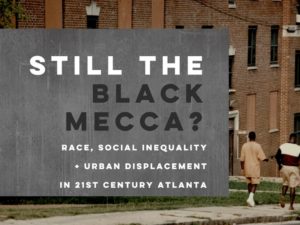
Can Atlanta still be considered the ‘Black Mecca?’ A mecca of equity? Opportunity for all? What about racial equality or Black economic growth?

The City of Atlanta has seen quite a few changes over the years in terms of social inequality, race and gentrification. Now leaders from three major Atlanta universities are looking for new ways to address these issues.

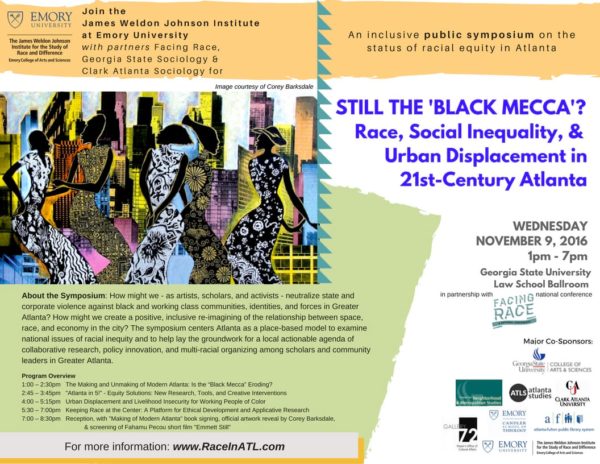
Emory University’s James Weldon Johnson Institute for the Study of Race and Difference, in conjunction with Georgia State University and Clark-Atlanta University, are set to host a half-day public symposium discussing the status of racial equity in Atlanta.

The conference, appropriately titled “Still the Black Mecca? Race, Social Inequality and Urban Displacement in 21st Century Atlanta,” will take place Nov. 9 at Georgia State University’s Law School. Local researchers, activists and grassroots leaders are welcomed to attend.

According to a Georgia State press release, the symposium will focus on three main goals: highlighting research initiatives of local universities surrounding agents of structural racism in the greater metro area; critically examining and encouraging political, cultural and economic solutions with the potential of positively affecting racial justice; and connecting both local and national scholars, activists, students and policy-makers, among others, to work together in achieving justice-oriented transformation.
black-mecca-2

“Much has been studied and said about Atlanta’s racial past, said Dr. Kali-Ahset Amen of the Emory University James Weldon Johnson Institute. “However, there is much yet to explore about the ways in which old patterns have held fast and found new expression in the present moment. We believe that this symposium addresses a need in Atlanta for honest, critical, and evidence-based conversations about the contemporary formulations of racialized dispossession, carcerality and social segregation in our city.”

“By bringing this crucial conversation to the public, our hope is to foster a much-needed exchange of knowledge and good faith among academics, activists and practitioners who are committed to working toward a more just future,” Amen added.
In addition, the symposium will also feature panel discussions, TED talk-style presentations, and issue debate sessions. Artistic commentary, such as the paintings of Atlanta artist Corey Barksdale, will also be incorporated to forward the event’s conversation around racial justice.
Interdisciplinary artist Fahamu Pecou will screen his newly released short film, “Emmett Still,” during the post-symposium reception as well, according to the press release.
“The ‘Still Black Mecca’ symposium is taking a multi-prong approach to addressing the status of racial equity in Atlanta,” said Zahra Alabanza, Chair of the Facing Race Host Committee, which also had a hand in organizing the symposium. “The intersectionality of scholars, activists, policy makers, research, grassroots tactics and other tools to address racial injustice is imperative to putting a dent in the issue that our city continues to face.”
For more information about the “Still the Black Mecca?” Symposium, please visit www.RaceinATL.com. 


Independent journalism still matters.

We hope this story was worth your time. For over 14 years, Atlanta Black Star has stayed Black-owned and independently run. We didn't get here by waiting on ad budgets that were never built to prioritize us. Our readers did that.

Corporate support for Black media has always been thin. Outlets like ours get roughly 1% of the $170 billion spent on U.S. advertising each year, and that margin is shrinking further as advertisers walk back the DEI-linked commitments they made in 2020. That's the backdrop. It's not why we're asking.

The wider picture isn't any steadier. Newspaper ad revenue has fallen more than 80% since 2005, and local newsrooms are closing at a rate of roughly two a week nationwide. When outlets go under, it's rarely the ones built to center a Black perspective from the ground up that get to stick around.

We know a request for support isn't why you came here. But without readers choosing to fund this work directly, the depth of reporting we can do at home and abroad shrinks along with everyone else's. If you're not in a position to give, that doesn't change how much we value you as a reader.

If you are able to, a recurring contribution does more for us than a single one-time gift, because it lets us plan the next investigation instead of just the next invoice. It takes about 30 seconds, no long form, no account. Thank you for continuing to support independent journalism and freedom of the press.

Back to top