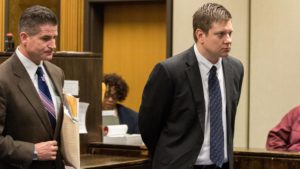
Chicago police Officer Jason Van Dyke, right, attends a court hearing with his attorney, Daniel Herbert, on Dec. 18, 2015. Photo by Zbigniew Bzdak / Chicago Tribune.
Once more, a Cook County judge has denied attorneys for a Chicago police officer charged in the murder of Laquan McDonald access to the teen’s protected juvenile records.
According to the Chicago Tribune, Judge Patricia Martin ruled Wednesday that although officer Jason Van Dyke is currently facing murder charges, that doesn’t automatically qualify him as someone with the right to view the confidential files.
Van Dyke shot and killed the Chicago teen in October 2014. Dash cam video of the ill-fated encounter showed the officer shooting McDonald at least 16 times, sparking outrage in the city of Chicago and nationwide protests.
Private records like McDonald’s, which detail the teen’s troubled past and time as a ward of the state, are usually kept under wraps. However, interested parties may gain limited access to such records if they can prove to a judge that their interest in disclosing the files far outweigh the confidentiality rights of the child, the Chicago Tribune reports.
Attorneys for Van Dyke argued that their client qualified as an interested party because specifics about the teen’s lees-than-perfect childhood — like his mental health issues and reported drug use — could help them in their murder defense.
Judge Martin disagreed.
“This is a serious charge, and I understand the serious implications of that,” she said. “But that in itself does not make him an interested party in a child abuse and neglect case.”
The officer’s attorneys submitted a request to view the protected files last year, which Martin flatly denied in August. This is the second time the judge has barred Van Dyke’s attorneys from viewing McDonald’s records.
“I don’t know who could be a more properly interested party,” said attorney Steven “Randy” Rueckert of the judge’s decision. “[Van Dyke is] looking at 45 years” minimum behind bars if he’s convicted.
Per the Chicago Tribune, lawyers for McDonald’s mother, Tina Hunter, also objected to the officer’s attorneys gaining access to the files. They called Van Dyke’s request to disclose the documents a stunt to shift focus away from the horrid shooting captured on video.
Rueckert, an attorney for the disgraced officer, contested the notion, stating that the request for McDonald’s records was simply part of the defense’s discovery process.
“It isn’t a fishing expedition, it’s discovery,” he said. “If there’s something in there that will help a defendant charged with murder, is this court going to deny my privilege?”
“One video has been shown to everybody in Chicago,” Rueckert added. “That’s not the case. That’s part of the case. There’s more videos … more evidence that people have not seen.”
When Martin denied the attorneys access to McDonald’s records the first time around, they went before another judge for permission to review over 8,000 pages of Illinois DFCS records on the teen’s life, the Chicago Tribune reports. The judge, Vincent Gaughan, later ruled that he himself would review the DFCS documents to determine if they contained anything that would help Van Dyke’s defense.
The disgraced officer has since been suspended without pay for his role in McDonald’s death. He’s also currently out on bond. There’s no word on whether his attorneys will seek to appeal Judge Martin’s decision.
The slain teen’s family reached a $5 million out-of-court settlement with the city of Chicago late last year.