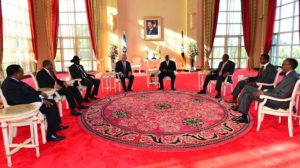
Prime Minister Netanyahu in a meeting with African leaders in Entebbe, Uganda (Photo: Kobi Gideon)
Prime Minister Benjamin Netanyahu’s recent visit to Uganda, Kenya, Ethiopia and Rwanda in July 2016 was the highlight of intense diplomatic activity aimed at strengthening relations between the State of Israel and the 40 sub-Saharan countries with which the state has diplomatic ties.
It was also the first visit by an incumbent prime minister since Yitzhak Shamir’s visit to Liberia, Ivory Coast, Togo and Cameroon in 1987.
The State of Israel is also conducting extensive secret diplomatic activity in a bid to resume or establish diplomatic ties with Muslim states in Africa which it has no diplomatic relations with. As part of this activity, on July 20, 2016, the State of Israel signed an agreement to resume diplomatic relations with the Republic of Guinea, the first state in Africa to sever its ties with the State of Israel in 1967 following the Six-Day War.
After the agreement was signed, Foreign Ministry Director-General Dore Gold visited Guinea on August 21 and met with the country’s president, Professor Alpha Condé, and with 10 of his ministers. They discussed cooperation in different fields and agreed to complete the ambassadors’ appointment process.
At the end of his visit to Guinea, Gold paid a rare visit on August 22 to a Muslim African state with which Israel has no diplomatic relations and met with senior officials there. Before this, on July 14, he visited Chad and discussed the renewal of diplomatic relations with Israel with its president, Idriss Déby. So far, the relations have not been restored.
The main goals of the extensive Israeli diplomatic activity in Africa are: An attempt to change the African states’ voting patterns at the UN, the African Union, and other international forums, as so far most African states continue to vote in favor of pro-Arab resolutions despite the fact that they have good bilateral relations with Israel; an attempt to win observer’s status or, at least, the status of an invited guest at the African Union; to expand trade relations between the State of Israel and African states; to aid African states in areas in which Israel has experience, such as agriculture, development, security and counterterrorism; and to curb the Iranian influence in Africa. At the moment, the State of Israel appears to be partially successful in reaching its objectives in Africa.
Read more here