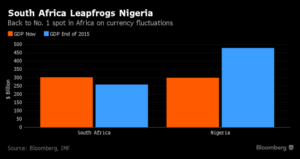
South Africa is once again the biggest economy on the African continent, a position it reclaims from Nigeria, thanks to a surging rand.
Using the gross domestic product at the end of 2015 published by the International Monetary Fund, Bloomberg reported that the size of South Africa’s economy is $301 billion at the rand’s current exchange rate, while Nigeria’s GDP is $296 billion.
Bloomberg noted that the rand has gained more than 16% against the US currency since the start of 2016, while in contrast, Nigeria’s naira has lost more than a third of its value.
In Afternoon trade on Wednesday, the rand firmed by more than a percent against the dollar, to R13.29.
The media agency pointed out that both Nigeria and South Africa are facing the risk of recession, having contracted in the first quarter of the year. Nigeria’s economy shrank by 0.4%, while South Africa’s GDP contracted by 0.2%.
Nigeria has suffered amid low oil prices, while South Africa is sensitive to shifts in the commodity cycle.
“More than the growth outlook, in the short term the ranking of these economies is likely to be determined by exchange rate movements,” Alan Cameron, an economist at Exotix Partners LLP, told Bloomberg.
He said that although Nigeria is unlikely to be unseated as Africa’s largest economy in the long run, “the momentum that took it there in the first place is now long gone.”
While the results of the recent municpal elections is feeding positive sentiment back into the markets, the South African Reserve Bank forecasts zero growth for 2016, while unemployment still remains above 26%.
In July, South Africa stepped past Egypt as the continents’ second largest economy in dollar terms, having dropped behind the North African country earlier in the year.
Read more here