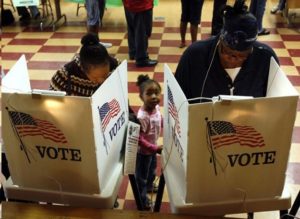
Image courtesy of Highbrow Magazine.
While most Americans agree there’s a lot at stake in the 2016 presidential election, African-American women seem to be most anxious about the outcome.
According to a Gallup poll released last week, nearly three in four Black women (72 percent) strongly agree that they’re afraid of what will happen if their candidate loses. White women came in a distant second with 56 percent, and Black men at 55 percent among those who expressed outright fear over the wrong candidate winning the presidency.
The poll also showed Latinos as being the least concerned with who wins, as only 38 percent of voters expressed fear over the election outcome.
The Washington Post reports that Black women voted at a higher rate than any of these groups in the 2008 and 2012 presidential elections, with exactly 74 percent of eligible African-American female voters casting ballots in the most recent one. The majority of these women also happen to be Hillary Clinton supporters. Their fear over the possibility of a Donald Trump presidency may be enough to drive them to the polls, thus playing a critical role in the selection of America’s next president.
So why are Black women so anxious? Former executive director of the National Council of Negro Women Avis Jones-DeWeever told the Post that the Gallup poll results were simply a reflection of her fears as a Black mother raising two sons in a climate of heightened racial tension between police and communities of color.
“There is nothing more fierce than a mother fighting to protect her child,” said Jones-DeWeever, who is also president of Incite Unlimited and an adviser to the Black Women’s Roundtable. “Although a lot of us may not be super excited about our options at this point in the game, I honestly think what we’re seeing in those [Gallup] numbers are black women saying we will do whatever is necessary to protect our children and that’s probably the best.”
Political consultant Rebekah Caruthers expressed similar sentiments and cited “those aggressive and sometimes hateful words” from Trump’s campaign as a source of concern for many Black women.
“Black women are fearful for the future of our families and Donald Trump almost seems like an existential threat to that,” Caruthers said. “I think that’s going to drive black women in droves to the polling place this year.”
While Trump has publicized support from African-Americans like former reality TV star Omarosa Manigault and boxing promoter Don King, many have yet to forget the real estate tycoon’s attacks on Black Americans, specifically President Barack Obama. At one point, Trump demanded that Obama present his birth certificate to prove he was a U.S. citizen and thus eligible for the presidency. According to the Washington Post, many African-Americans saw that as a racially motivated attack on the nation’s first Black president.
“African-American women disproportionately see discrimination still as an issue for us to deal with,” said Michele Jawando, vice president for legal progress at the Center for American Progress. “So yes, African Americans, based on the rhetoric, are going to feel more concerned about who’s elected.”
Jawando also said that researchers found racial discrimination to be one of the top issues for Black women heading into this year’s presidential election.
According to the Gallup site, poll results were based on phone interviews conducted between June 7 and July 1 with a sample size of 3,270 adults, aged 18 and older, living in all 50 states and the District of Columbia. The survey interviewed over 900 African-American and Latino adults and more than 1,300 whites.


