University of Leicester
Archaeologists have made a fascinating discovery in a remote Caribbean island cave: 16th-century Christian symbols left by European explorers alongside ancient indigenous art, offering a glimpse into the colonization of the Americas.
The small island of Mona, which sits between the Dominican Republic and Puerto Rico, is filled with caves; caverns on the island were sources of freshwater, and marks made by indigenous people commonly appear near the water sources. (Christopher Columbus visited the island in 1494.)
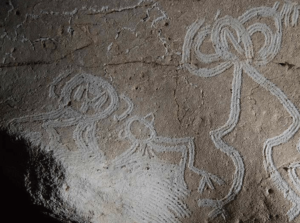
But it’s cave number 18 that has caught scientists’ eyes. Inside the cave, which is over half a mile long, researchers have found about 250 indigenous markings in the walls and ceilings, according to a new study. These were made by what archaeologists call “finger fluting,” in which indigenous people used one or several fingers to draw on the cave.
What makes the cave even more interesting for the researchers is that its walls also record the presence of European visitors, with drawings of Christian crosses and even phrases written in Latin and Spanish. The European marks, which number over 30, the researchers report, are slightly higher above the ground than the indigenous symbols, in the places where they are near each other.
The walls can be read. Someone wrote “God made many things” in one spot in the cave, and in another place, the words “may God forgive you” appear. There’s also a Latin quote from the Bible, which the researchers translate in their study as meaning, “And the Word was made flesh [and dwelt among us].”
There are multiple Christian crosses in the cave, frequently drawn near indigenous art, the scientists report in the study, which was published in the journal Antiquity. The researchers even know the order in which the crosses were drawn: first the vertical line, followed by a left-to-right drawing of the horizontal, like a blessing by a right-handed person, the study says.
Read more here.