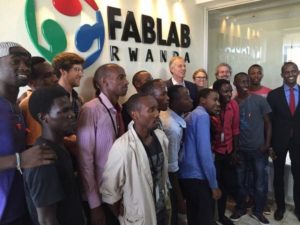
FabLab in Rwanda (Photo via Solidworks.com)
You would expect to see the words ‘Made in Rwanda’ on a jar of coffee, but probably not on a laptop.
Rwanda is becoming a hub of tech activity with its recently launched innovation hub FabLab, a space for members to turn tech ideas into products. The East African country has also seen success with FOYO, a mobile pharmaceutical directory, as well as a new cashless bus payment system in the capital city Kigali.
Rwanda hosted the World Economic Forum on Africa in May, and work is reportedly well underway on the Kigali Innovation City, which will house innovation labs and provide training and funding for technology companies.
Rwanda has developed quickly — the country’s GDP growth averaged at 8 percent per annum between 2001 and 2015, and child mortality dropped by two-thirds.
This rapid development was underpinned in 2000 by the launch of Vision 2020, when the country was linked to an international network of global wireless networks, in a campaign that aimed to “transform the country into a knowledge-based middle-income country.”
One tech company taking advantage of these developments is South American technology firm Positivo BGH, responsible for building the first ever ‘Made in Rwanda’ laptops in Kigali.
Their mission is to increase access to technology in the country, and allow more Rwandans to communicate online from home.
‘Proudly made in Africa’ is the tagline the company uses in their marketing materials, and the expansion from South America is already benefiting Rwandans looking for work.
“Right now we have 50 direct staff but if you count indirect, like security and cleaning, we have created about 120 positions,” said Juan Ignacio Ponelli, president of Africa at Positivo BGH.
Most of the staff are from the local area and were trained by expats, and Ponelli hopes the move to Rwanda will help raise brand awareness outside of South America.
“It’s a strategic decision for the company to go global. We are a top company in technology but we are known really just in South America. So right now we decided to go global and chose here [Rwanda] to start the international arm for this group.”
Read more here.