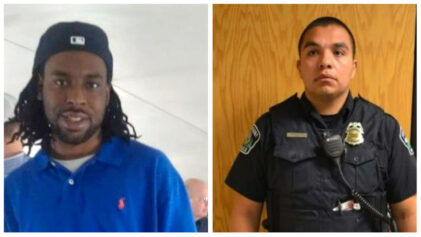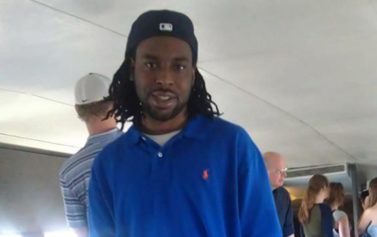
Philando Castile, 32. Facebook.
A case of racial profiling may have led to 32-year-old Philando Castile’s fatal encounter with St. Anthony, Minnesota police on July 6, according to audio obtained by a local news organization.
“I’m going to stop a car,” an officer says on what appears to be a police scanner, according to NBC affiliate KARE. “I’m going to check IDs. I have reason to pull it over.”
“The two occupants just look like people who have been involved in a robbery,” the man continued. “The driver looked more like one of our suspects, just ’cause of the wide-set nose.”
Just 90 seconds later, the officer reports a shooting at “Larpenteur and Fry.”
Though the news station warns it has not been able to verify the authenticity of the recording, investigations have confirmed that the license plate number mentioned by officers matches the car Castile was driving and that the location referenced lines up with the traffic stop.
The new development conflicts earlier reports that Castile and girlfriend Diamond Reynolds had been stopped for a broken taillight. Family members have come forward to share their opinions on the matter.
Reynolds told 11Alive News that she and Castile did not fit the descriptions on the audio, while uncle Clarence Castile questioned the officer’s claims plainly.
“I just thought it was kind of insane to pull somebody over saying they matched a robbery suspect by having flared nostrils,” he said. “It is kind of hard to see flared nostrils from a car.”
For the deceased cafeteria manager, the traffic stop was only the latest of at least 52 in recent years. The Associated Press reports over half of the 86 violations — for misdemeanor offenses such as failure to wear a seatbelt or driving without proof of insurance — were dismissed in court.
A 2014 Bureau of Justice Statistics survey found that 13 percent of African-American drivers were pulled over by police at least one time in 2011, while only 10 percent of whites and Hispanics reported a stop that year. And in 2008, the BJS found that Black drivers were three times more likely than white drivers and twice as likely as Hispanic drivers to be searched during a traffic stop.
Officer Geronimo Yanez has been identified as the shooter and was placed on administrative leave along with the second responding officer, Joseph Kauser. Yanez’s attorney Thomas Kelly told the AP Saturday the cop was “reacting to the actions of the driver.”
“This had nothing to do with race. This had everything to do with the presence of a gun,” Kelly said.
Reynolds, Castile’s girlfriend who live-streamed the shooting’s aftermath on Facebook, has said that the officer opened fire after Castile informed him he had a gun and was reaching into his wallet to produce identification.
“I told him not to reach for it. I told him to get his hand off it,” the officer tells Reynolds in the chilling Facebook video.
“Please, officer, don’t tell me that you just did this to him,” Reynolds laments as Castile loses consciousness. “You shot four bullets into him, sir. He was just getting his license and registration, sir.”
Police Scanner Audio below