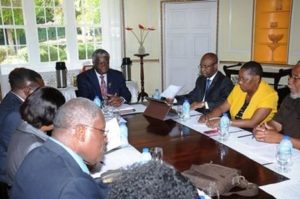
Prime Minister Stuart at a meeting with reparation stakeholders (photo via Caribbean News Now)
Bridgetown, Barbados (BGIS) — Barbados Prime Minister Freundel Stuart has reiterated that “the reparations issue is not based on a diplomacy of protest, but on a diplomacy of engagement.”
Stuart made the comments recently, while chairing a meeting of reparation stakeholders.
Those present at the near three-hour meeting included minister of culture, Stephen Lashley; acting minister of foreign affairs, Steve Blackett; Barbados’ ambassador to CARICOM, Robert Morris; permanent secretaries Sonja Welch, Cecile Humphrey and Ruth Blackman; chairman of Barbados’ Task Force on Reparations, Professor Dr. Pedro Welch; and director of the Commission of Pan African Affairs, Dr. Deryck Murray.
The prime minister said there had been deficits in the society as a result of the horrible experience of slavery and the transatlantic slave trade and stressed that there was definitely a need for reparatory justice.
“We can’t live our lives in the past, but there are legacy issues coming out of that slave experience … Reparations is therefore an important issue,” he said.
Stuart noted that it would take some time to get to the destination that Barbados and the Caribbean Community was seeking on the matter of reparations.
“This will be a long process because even after we engage Europe, any programs we agree on will take some time before they are implemented,” he stated.
The prime minister also expressed the view that people in the community must be sensitized to the issue of slavery and its impact on both slaves and slave owners, so that the reparations flame could be kept burning.
Read more here.