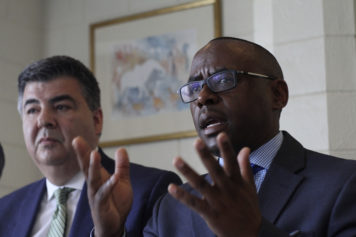
Safaricom CEO Robert Collymore (via Capital FM Kenya)
In Africa, local taxi companies and startups have been working hard to compete with Uber, but the ride-hailing company has managed to outmaneuver most of them. Uber, now in 10 sub-Saharan African cities, might now be facing its first real challenge in Safaricom, East Africa’s largest mobile phone network.
Safaricom — best known for the creation of the world’s most-used mobile money platform, M-Pesa — is launching a ride-hailing service in Kenya that will equip cars with free wifi, M-Pesa payment options, and connectivity on the Safaricom network. It will be called Little Cabs, according to the company’s chief executive Bob Collymore.
“It is effectively a rival for Uber,” Collymore said in an interview with Reuters this week. “It is a local competitor which will be cheaper and better for the local community.”
In response to the news, Samantha Allenberg, a spokesperson for Uber Africa, told Quartz, “We do not focus on competitors but rather spend our time thinking about how we can better the experience for riders and driver-partners. However, Uber loves choice as it creates competition and a better experience for the consumers.”
Safaricom’s network is the most used in Kenya and M-Pesa has over 20 million users in the country. (In an acknowledgement of M-Pesa importance, Uber introduced a cash option in Kenya that would allow users to pay for rides with M-Pesa or cash.)
If successful, Little Cabs may be another step for setting up Safaricom as a platform for a range of services. Through M-Pesa, Safaricom already offers users credit lines linked to local banks. A rural solar provider M-Kopa is also connected to M-Pesa.
Little Cab’s success against Uber isn’t guaranteed. The motivation for Little Cabs, according to Collymore, is to find new revenue streams and as Odipo Riaga, a tech blogger in Kenya, observes, Safaricom is not known to hang on to any venture for too long if it’s not profitable. In contrast, Uber is ramping up its presence on the continent with launches in two new cities just this month, Kampala in Uganda and Accra in Ghana.
Read more here.