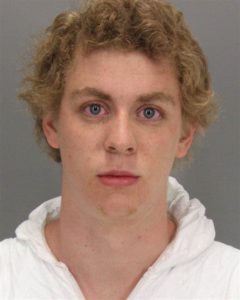
Brock Turner’s January 2015 Mug shot. Santa Clara County Sheriff’s Office.
Santa Clara County Superior Court Judge Aaron Persky sent the world into a frenzy when he sentenced convicted rapist Brock Turner to just six months in jail last Thursday.
The former Stanford University freshman was found guilty on three counts of felony sexual assault in March and faced up to 14 years in prison.
Many saw the soft sentence as an affront to sexual abuse victims everywhere and a testament to the power gender and class continue to wield over the American criminal justice system.
Others noted the stunning racial bias, angered by authorities’ handling of the one-time All-American swimmer’s image. Santa Clara County and Stanford officials withheld mugshots of Turner until Monday. Until then, the most popular photo published by media outlets was that of a smiling, suited-up privileged white male. A stark contrast to the bleak booking photos that traditionally accompany stories about African-American offenders, alleged or convicted.
Civil rights advocates argued a Black man in similar circumstances would most definitely have received prison time, if not the maximum penalty.
Two vastly different, yet equally evocative letters further intensified the collective outrage: the victim’s 7,000-word impact statement to the judge and a remarkably oblivious plea by the perpetrator’s father to spare the 20-year-old prison time.
The unidentified woman’s powerful remarks on the system’s criminalization of female rape victims, released in full by BuzzFeed and Palo Alto Online, captivated the nation.
“I was pummeled with narrowed, pointed questions that dissected my personal life, love life, past life, family life, inane questions, accumulating trivial details to try and find an excuse for this guy who didn’t even take the time to ask me for my name, who had me naked a handful of minutes after seeing me,” she wrote in the 12-page letter.
“After a physical assault, I was assaulted with questions designed to attack me, to say see, her facts don’t line up, she’s out of her mind, she’s practically an alcoholic, she probably wanted to hook up, he’s like an athlete right, they were both drunk, whatever, the hospital stuff she remembers is after the fact, why take it into account, Brock has a lot at stake so he’s having a really hard time right now.”
Dan A. Turner wrote about all the ways his “happy go lucky” son’s life had changed for the worse since the incident and resulting trial.
“These verdicts have broken and shattered him and our family in so many ways. His life will never be the one that he dreamed about and worked so hard to achieve.”
The elder Turner lamented the fact that his son would have to register as a sex offender, which “forever alters “where he can live, visit, work and how he will be able to interact with people and organizations.”
“He has no prior criminal history and has never been violent to anyone including his actions on the night of Jan 17th 2015,” he added.
Now multiple publications are releasing dozens more character testimonials submitted by Turner’s family and friends. The letters paint Turner as a thoughtful, introverted young man, nothing like the hardened criminals he would surely encounter in prison.
Judge Perksy, reported Stanford alumnus and subject of a 150,000-signature petition to remove him from the bench, said the letters weighed on his decision.
“I need you to know that my younger brother is not the predatory and unremorseful assailant that he was made out to be,” older sister Caroline Turner wrote. “Brock is a kind, quiet, talented, hard-working, deeply caring, sensitive, peculiar, inquisitive, and most importantly, vulnerable young man.
From mother Carleen Turner:
“I beg of you, please don’t send him to jail/prison. Look at him. He won’t survive it. He will be damaged forever and I fear he would be a major target. Stanford boy, college kid, college athlete – all the publicity. This would be a death sentence for him. Having lost everything he has ever worked for his entire life and knowing the registry is a requirement for the rest of his life certainly is more than harsh. His dreams have been shattered by this.”
From family friend and physician-engineer Dean Olson:
“From scientific evidence I have studied during my education and from my experience, alcohol is a depressant and a chemical that can release inhibition and magnify both positive and negative personality traits…It is not however a substance that dramatically changes someone’s intrinsic personality traits, suddenly altering someone from being mild mannered to criminalistics. I am afraid this is how it is sometimes portrayed and that Brock may have been depicted in a similar fashion.”
From friend Anne Whalen:
“I have been with Brock while he has been drinking a few times within the past two years. While consuming alcohol in my presence, Brock was the same great guy he was while sober. He was always in control and continued to act rationally and be himself all night.”
From friend Leslie Rasmussen:
“I don’t think it’s fair to base the fate of the next ten + years of his life on the decision of a girl who doesn’t remember anything but the amount she drank to press charges against him. I am not blaming her directly for this, because that isn’t right. But where do we draw the line and stop worrying about being politically correct every second of the day and see that rape on campuses isn’t always because people are rapists.”


