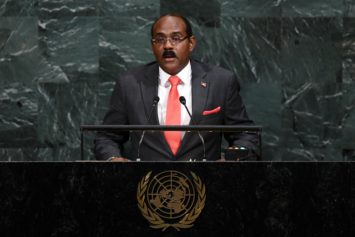
Anthony Bailey (L) visits Antigua
ST. JOHN’S, ANTIGUA — A diplomatic passport issued by Antigua and Barbuda to one of its “special economic envoys,” Anthony Bailey, inaccurately states that he is a national of that country, raising yet more questions over the issue of such passports by Caribbean countries.
In providing a copy of Bailey’s diplomatic passport and asserting that this was proof of his citizenship, his London lawyers, Carter-Ruck, appeared to treat the concepts of nationality and citizenship as one and the same, which they are not, and in any case Bailey is neither a national nor a citizen of Antigua and Barbuda.
Under Antigua and Barbuda law, nationality is acquired only by birth, by descent or by naturalization, the last of which requires seven years continuous residence, public advertisement and no public objections. Bailey is not a national of Antigua and Barbuda on any of these qualifying bases.
Citizenship, however, may be granted by a country regardless of nationality and, in the case of Antigua and Barbuda is frequently granted under its citizenship by investment program, which requires a specified minimum investment in a qualifying property or business, or a donation to the country’s National Development Fund.
Bailey’s lawyers claimed that the governor general of Antigua and Barbuda, Sir Rodney Williams, in September 2015, congratulated their client in writing on the notification that his citizenship application had been completed.
Why the governor general would have done this is unclear since there was no legal basis for Bailey to apply for citizenship and, in fact, he did not do so, as Carter-Ruck admits by saying,“Our client did not formally apply for citizenship of Antigua and Barbuda, but it was granted to him on the basis of his diplomatic economic role.”
According to government records in Antigua, Bailey has never been granted citizenship, whether by investment or otherwise.
A senior government source in St. John’s told Caribbean News Now that Bailey did in fact suggest to the government of Antigua and Barbuda that he should be entitled to citizenship by investment on the purported grounds that money donated to local Catholic churches by The Sacred Military Constantinian Order of Saint George was really his. This suggestion was rejected by the government.
Read more here.