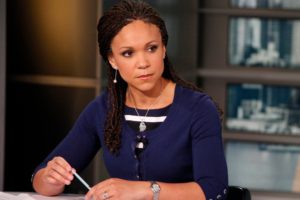
Former MSNBC anchor Melissa Harris-Perry recalled not wanting to be treated as a “little brown bobble head”by former employers at the news network.
Harris-Perry told Democracy Now! that in the heat of the election, MSNBC executives pushed the focus of the network to play-by-play coverage of the upcoming elections, which resulted in the elimination of her weekly program,the Melissa Harris-Perry show.
In February, she addressed in an e-mail her discontent to co-workers and her fellow staff members about the direction MSNBC is taking in its racial composition and the dramatic changes it has made in the networks editorial tone.
“I have hosted a weekly program on this network for four years and contributed to election coverage on this network for nearly eight years, but no one on the third floor has even returned an email, called me, or initiated or responded to any communication of any kind from me for nearly a month,” she said in the e-mail released by a co-worker on Medium Corporation.
Apparently, according to Harris-Perry’s e-mail, the former host acertain that MSNBC executives were preventing her from hosting her own show and denying her the editorial control that she’s had for the past four years.
“I am not a token, mammy or little brown bobble head,” she said in the e-mail. “I am not owned by Lack, Griffin or MSNBC.” The senior vice president of talent and diversity, Yvette Miley, told CNN that the MHP show, like others on MSNBC, was only pre-empted in order to focus on the contentious 2016 presidential primary contest and said there were no plans to cancel it or strip Harris-Perry of editorial control.
Miley stated, “MSNBC is the place for politics, and as we’re covering 2016 part of that coverage meant that we were going to look for opportunities during the course of 2016 to really focus on the race for the White House,”she said. “There were pre-emptions that impacted shows across the network.”
Days following Harris-Perry’s descriptive e-mail, MSNBC announced across its network that it was “parting ways” with the longtime anchor.
As Harris-Perry explained to Democracy Now!’s Amy Goodman, she felt particularly affronted by the MSNBC’s decision to let her go, given that Brian Williams returned to the network after a six-month suspension for fabricating his own reporting experiences on air.
“They said things like we’re in an MSNBC family where second chances always possible, where redemption is an important part of who we are,” she said. “It is frankly painful that after four years of working extremely hard for these people, after giving up a lot of family time and personal time and professional time, to be discarded in that way.”
As Harris-Perry closed her e-mail of bottled frustration, she stated that she’s only willing to return to the station under certain terms.
“I am not hungry for empty airtime. I care only about substantive, meaningful, and autonomous work,” Harris-Perry said.