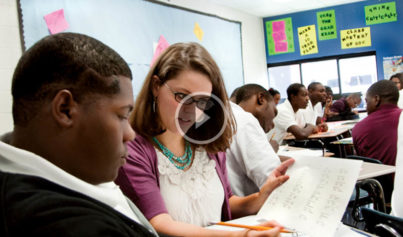
USA, California, Los Angeles, Teacher and schoolboy (14-15)
Teachers have a big impact on the success of students, as their support — or lack thereof — helps chart a course for young minds. When one factors race into the equation, the consequences can be particularly devastating for Black students who are subjected to white teachers who doubt their ability and question their potential for success.
A new study to be published in the Economics of Education Review found that when teachers have lower expectations of their students, these can translate into self-fulfilling prophecies. If teachers don’t expect their students to achieve, this could impact student performance, especially disadvantaged children who may not have role models to counter a teacher’s low expectations. The study —“Who believes in me? The effect of student-teacher demographic match on teacher expectations” — was co-authored by Nicholas Papageorge, an economist in the Krieger School of Arts and Sciences at Johns Hopkins University; Seth Gershenson, assistant professor of public policy at American University; and Stephen B. Holt, a doctoral student at American University.
The trio focused on data from the Educational Longitudinal Study of 2002, which examined 8,400 10th-grade public school students. In the study, Black and white teachers were asked to assess the students and predict the level of education they believed the students would attain. While the teachers made the same predictions concerning white students, they differed in their assessment of Black students.
Specifically, the study found that white and other non-Black teachers were 12 percentage points more likely than their Black counterparts to predict Black students would not graduate from high school. In addition, non-Black teachers were 5 percent more likely to predict Black boys’ failure to graduate than Black girls.
When a white teacher and a Black teacher assessed the same Black student, the white teacher was 30 percent less likely to predict the student will graduate with a four-year college degree. Moreover, the white teacher was nearly 40 percent less likely to expect the Black student to complete high school.
Further, white male teachers are 10 to 20 percent more likely to have low expectations for Black girls. But Black female teachers are considerably more optimistic about the ability of Black boys to succeed than any other group. Black women teachers were 20 percent less likely than white teachers to say a student would not graduate, and 30 percent less likely than Black male teachers.
The study also revealed that math teachers had significantly lower expectations for female students. And as for Black students, especially Black boys, biased expectations have long-term effects on students. A non-Black teacher in a 10th grade class made Black students far less likely to pursue that particular subject by taking similar classes.
“What we find is that white teachers and Black teachers systematically disagree about the exact same student,” Papageorge said of the research. “One of them has to be wrong.”
“If I’m a teacher and decide that a student isn’t any good, I may be communicating that to the student,” Papageorge added. “A teacher telling a student they’re not smart will weigh heavily on how that student feels about their future and perhaps the effort they put into doing well in school.”
 The authors believe that these findings have far-reaching implications beyond education, extending to the workplace and beyond.
“While the evidence of systematic racial bias in teachers’ expectations uncovered in the current study are certainly troubling and provocative, they also raise a host of related, policy-relevant questions that our research team plans to address in the near future,” Gershenson said. “For example, we are currently studying the impact of these biased expectations on students’ long-run outcomes such as educational attainment, labor market success, and interaction with the criminal justice system.”
This most recent study comes as others have already sounded the alarm on the crisis of a lack of teacher diversity in public schools across the U.S., and the role of teacher bias in the paucity of Black students in gifted and talented programs. While white and Asian students dominate these advanced classes, the presence of Black teachers increases the likelihood of Black students being placed in these programs threefold.
As Atlanta Black Star has reported in the past, of the over 3 million public school teachers in America, more than 80 percent of them are white women. This racial imbalance has an impact, particularly with regard to the instruction of Black boys, leading to lower-quality instruction and lower grades, more referrals to special education, and far more expulsions and suspensions.