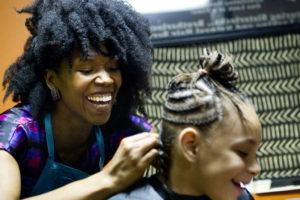
Photo by Katie Currid for The Oregonian
Regulations in Kentucky will require African hair braiders to take about 1,800 hours of various coursework and take a six-month internship in order to obtain a license.
The regulations, approved earlier in March, are only the tip of the iceberg. Kentucky legislators are planning to tack on an additional $1,500 to insure that hair braiders will be properly licensed.
Democratic Kentucky State Rep. Hubert Collins has been at the forefront of the amendment. His wife currently chairs the Kentucky Board of Hairdressers and Cosmetologists and this connection has made many suspicious.
Democratic State Rep. Reginald Meeks said he has asked Collins to remove the amendment. Others, like Julia Crigler, Kentucky state director for the Americans For Prosperity, was more crass about her stance on the subject:
“We have elected officials seemingly putting their personal interests, in this case his wife’s personal interests, ahead of regular people trying to contribute to their communities.”
According to the Institute of Justice, the regulations would halt the work of braiders who have been doing hair for years. In a statement released earlier this week, the Institute of Justice said that:
“Kentucky’s laws are some of the worst in the nation, tied with two other states for 44th place … This burden is absurd when applied to natural hair braiding, which traces its roots back over 5,000 years to Africa and is an important form of cultural expression.”
African hair braiding is a rich tradition that has been practiced in various African societies throughout human history. Many of the women who have come to the United states have immigrated from West African nations like Senegal, Ivory Coast and Togo. This art form has become an easy and efficient way to achieve the American dream and make money. Many African immigrant women have come to rely on braiding as a secure source of income in the transitional phase.
The Institute of Justice has been working diligently to counter the issue at hand. They have partnered with Kentucky State Senator Perry Clark, who has introduced S.B. 269. According to their website, the bill will define “natural hair braiding” and “exempts these braiders from the requirement to have a cosmetology license.”
“S.B. 269, which the House and Senate passed and now awaits the governor’s signature, exempts braiders from these current requirements,” says Christina Walsh Director of Activism and Coalitions for Institute for Justice
Update: Walsh wrote in an email to Atlanta Black Star stating that:
“Rep. Collins’ amendment, which would have required braiders to pay $1,500, pass an exam and be U.S. citizens, was defeated (he chose not to bring it up on the House floor, presumably due to its unpopularity, and instead simply voted “no” on S.B. 269).”