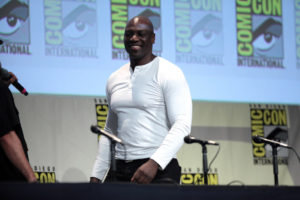
Adewale Akinnuoye-Agbaje speaking at the 2015 San Diego Comic Con International, for “Suicide Squad” (Flicker)
In a new interview detailing an upcoming movie he’s developing, Adewale Akinnuoye-Agbaje says he thought he was white growing up.
The former “Lost” star is developing a film about his life called Farming, and he tells The Guardian he grew up thinking of himself as white and feared Black people.
Akinnuoye-Agbaje was raised since he was six weeks old by white British foster parents because his Nigerian parents engaged in “farming,” a practice that was common throughout Britain in the 1960s and 1970s where Nigerian children were informally fostered by white families. He grew up surrounded by others who violently feared Blacks.
“I just remember being petrified,” he tells The Guardian. “It was as if they were the bogey man to us. Fish and chips and corned beef, that’s what I knew. Do you know what I mean?”
Aside from the language barrier that he had to deal with after going to Nigeria with his birth parents at age 8, Akinnuoye-Agbaje went back to Britain with his white parents the next year, and the 9-year-old faced more torment than ever before, since his skin became darker from the African sun. Akinnuoye-Agbaje was fighting both at home with his foster siblings and on the street. As a teenager, he built a reputation for violence.
To defend himself and avoid confrontation from white people, he became a Skinhead. Akinnuoye-Agbaje adopted the clothes, haircut and racism associated with the group that he says ran the streets in Tilbury, a town in the borough of Thurrock, Essex, England. Initially, he was “like a little dog that followed them around.”
“I was so eager to repudiate any connection with any immigrant race, I would go above and beyond. I was desperate to belong to something. That was my drive as a teenager,” he says to The Guardian.
In a 2014 interview with Arsenio Hall, Akinnuoye-Agbaje said he fought his way into the Skinheads and wound up running the gang. Eventually, his Nigerian father, a lawyer, took him out of the gang and he was homed with another white family. Akinnuoye-Agbaje eventually worked his way through law school and ultimately received a bachelor’s and master’s degree in law before becoming an actor.