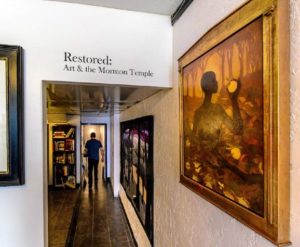
J. Kirk Richards’ painting, “Eve and the Fruit of the Tree of Knowledge,” hangs in the Provo gallery and bookstore Writ & Vision, in Provo, Utah. (Trent Nelson/The Salt Lake Tribune)
A painting in a Provo, Utah art gallery depicting a semi-nude Black woman is raising controversy in Mormon circles, but not for the expected reasons.
According to The Salt Lake Tribune, some Black feminists say the painting by J. Kirk Richards, which portrays a topless Black woman as Eve, smacks of exploitation.
Mica McGriggs, a doctoral student in psychology at Brigham Young University, said she took issue with the nudity, which conjured up painful memories.
“At first look, its beauty captured me,” said McGriggs, “but within seconds all of our history and trauma as a people flooded back and its beauty was tainted.”
According to McGriggs, who specializes in multiculturalism, white nudity is handled differently from Black nudity. She also had a problem with a white artist portraying a nude Black woman.
“As soon as a white Mormon man decides to ‘reimagine’ Eve as Black, she is naked and up for auction,” McGriggs said. “White nudity is completely different than Black female nudity. Black women and nudity equals nakedness, sexual brutality and enslavement. Unless it is carefully crafted by another Black woman, it is a type of pornography that white people flock to fund.”
Bryndis Roberts, another Black feminist, also had a problem with the painting, especially the nudity.
“We are not in a vacuum; our actions cannot stand alone and apart from history. … This depiction with more of a focus on her breasts than her face is far too similar to pictures of Black women on the auction block,” said Roberts, co-founder of Feminist Mormon Women of Color. “You are essentially erasing the personality of all Black women, just as we have been historically erased.”
The Church of Jesus Christ of Latter-day Saints has a controversial history with Black people. Black men were barred from being ministers in the church until 1978, when church leaders had a new revelation. Joseph Smith, the founder of the Mormon church, taught that Black people were cursed as “the sons of Cain.” However, the modern LDS church has distanced itself from those teachings.
“The church disavows the theories advanced in the past that Black skin is a sign of divine disfavor or curse, or that it reflects actions in a premortal life; that mixed-race marriages are a sin; or that Blacks or people of any other race or ethnicity are inferior in any way to anyone else. Church leaders today unequivocally condemn all racism, past and present, in any form,” according to a statement published on the church’s website.
Roberts, the artist who created the piece, said portraying Eve as a Black woman was a progressive move.
“Whether a literal person or a representation of our earliest ancestors, I’m convinced Eve was black,” he said. “Depicting her as a blond Caucasian would, in my mind, perpetuate a racial myth and stereotype.”
Roberts says he painted a nude white Eve and received criticism from socially conservative Mormons, who don’t like to see any nudity in artistic images. He also rejected the suggestion that the image was pornographic. According to Roberts, the human body “is beautiful in all its shapes and colors.”