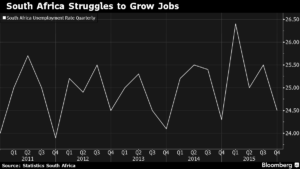
South Africa’s worst drought in more than a century is taking its toll on the economy as farms cut jobs and the cost of producing food surged.
Employment in agriculture decreased by 37,000 in the fourth quarter of last year, offsetting some job gains in government and finance and contributing to the 24.5 percent jobless rate, the Pretoria-based statistics office said in a statement on Thursday. Producer inflation for manufactured goods accelerated to an 18-month high of 7.6 percent in January, and price growth for agriculture, forestry and fishing more than doubled to 23.6 percent from the previous month, Statistics South Africa said in a separate statement.
The price of white corn has more than doubled since the start of last year, and the cost of the yellow variety rose 56 percent. The white type is used as a staple food known locally as pap, while the other is mainly fed to animals.
“Food prices are probably the No. 1 upside risk to South Africa’s near- to medium-term inflation outlook and could perhaps reach double digits in CPI food earlier than we had anticipated,” Jeffrey Schultz, an economist at BNP Paribas Securities South Africa, said in an e-mailed note. “This will unsettle the Reserve Bank.”
Consumer inflation accelerated to 6.2 percent in January, the fastest rate in 17 months. The central bank, which targets price growth in a range of 3 percent and 6 percent, raised its benchmark repurchase rate by 50 basis points to 6.75 percent on Jan. 28.
Finance Minister Pravin Gordhan on Wednesday cut the nation’s 2016 growth forecast to 0.9 percent, which will be the slowest since a recession seven years ago, and said the drought is a risk to the growth and budget targets. Gordhan allocated 1 billion rand ($64 million) to support farmers to increase water supplies by drilling boreholes and buying water tankers, move animal herds and providing feed.
The drought has pushed an additional 50,000 people in South Africa below the poverty line of 501 rand a month, the World Bank said earlier this month.
Source: www.bloomberg.com