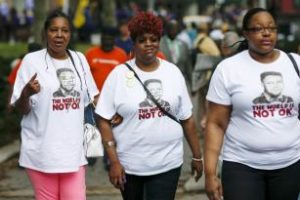
At right, Eric Garner’s widow, Esaw Garner (l.), daughter Emerald Snipes Garner (l.) march at a rally demanding police reforms last year in Brooklyn. (Eduardo Munoz/Reuters)
The family of Eric Garner, a Black man choked to death by New York police, has received a $1 million settlement from the hospital that dispatched an ambulance to the scene.
According to court papers acquired by The Associated Press, the settlement with Richmond University Medical Center of Staten Island is separate from the $5.9 million settlement with the city of New York.
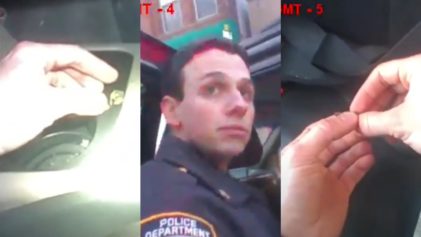
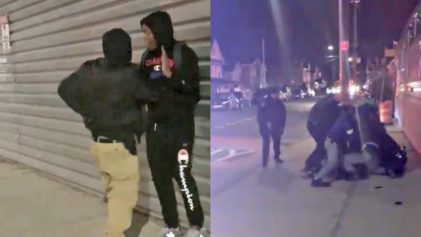
Garner died in 2014 after an encounter with police who were trying to arrest him for selling loose cigarettes. He was wrestled to the ground by several police officers. Officer Daniel Pantaleo also wrapped his arm around Garner’s neck in an illegal choke hold. Pantaleo has yet to be charged with a crime. Garner was captured on video saying “I can’t breathe,” which became a rallying cry for Black Lives Matter activists.
When the emergency medical team arrived on the scene at 3:36 p.m., Garner was still breathing but not responsive. Hospital records show Garner went into cardiac arrest on the stretcher. Doctors attempted to revive him at the hospital, but he was declared dead at 4:34 p.m. The medical examiner’s report listed one of the causes of death as the choke hold applied by police. Court papers accused the medical team of failing to provide the necessary life-saving techniques.
Two EMTs and two medics were suspended over the incident, but they have now been assigned to duties that do not require patient care, according to The New York Daily News.
The AP said court papers also listed details of how the money from the various settlements from Garner’s death will be divided. Here are the details:
- Garner’s widow, Esaw Garner, will receive about $2.4 million.
- His six children will receive sums ranging from $195,000 to $996,000.
- Garner’s mother, Gwen Carr, receives $124,000, for acting as administrator of his estate.
- The law firm representing the family receives $2.3 million, a third of the settlement money. Sanford Rubenstein, an attorney who first represented the Garner family, is still fighting to receive compensation. He was fired after he was accused of sexual assault, but the charge was later dropped.
Since his death, the Garner family has often spoken out against police violence. Garner’s daughter, Erica Garner, recently appeared in an ad supporting Democratic presidential candidate Sen. Bernie Sanders. In the ad, Erica Garner talks about how her father’s death has spurred her to become an activist and compared herself to Martin Luther King and Malcolm X. She now spends every Tuesday and Thursday protesting police violence.
“I feel like a representative for people throughout this whole nation because I’m doing this, I’m speaking out,” she says in the video.