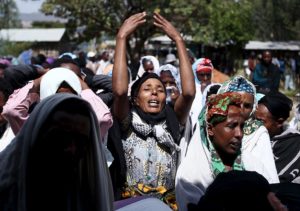
Women mourn during the funeral ceremony of a primary school teacher who family members said was shot dead by military forces during protests in Oromia, Ethiopia in December 2015. (Reuters)
The Ethiopian government is reportedly continuing its crackdown on the Oromo people.
According to the New York-based Human Rights Watch, about 200 protesters have been killed in the latest government operation. Oromia, home to the Oromo people, is Ethiopia’s largest region. Demonstrations in the region broke out when the government attempted to clear a forest for an investment project. Protests escalated when the government decided to expand the borders of Addis Ababa, Ethiopia’s capital, to incorporate surrounding towns in Oromia, according to The International Business Times.
Government forces have used heavy-handed tactics to squash the protests, including rounding up and detaining protesters, torture and even extra-judicial killings, according to The Atlanta Blackstar. Many of the early protests were led by students, but that has not stopped the violence from security forces.
“They walked into the compound and shot three students at point-blank range,” said a 17-year-old student in a Human Rights Watch report. “They were hit in the face and were dead.”
The IBT said there are almost daily reports of killings.
“Things have become considerably more violent in the last few days,” said Felix Horne, Horn of Africa researcher at Human Rights Watch. “The government needs to back down and stop the brutal crackdown.”
It’s difficult to get accurate information about what’s going on because Ethiopia does not have a free media. Human Rights Watch says it is relying on information leaking out via social media posts. The foreign-based Oromo Media Network is also reporting on the situation. However, its signals have been jammed by the Ethiopian government. Government forces have also reportedly smashed OMN satellites and jailed people who have shown their broadcasts.
However, the Ethiopian government denies there is a problem and dismissed Human Rights Watch’s latest report.
Getachew Reda, Ethiopia’s communications minister, told the BBC the report was an “absolute lie” and questioned how Human Rights Watch could report on the situation from New York. He also blamed the latest violence on armed gangs “who are trying to stir up emotions in the public.”
According to The IBT, the European Parliament passed a January resolution condemning the government’s crackdown on largely peaceful protesters. However, the U.S. government has not criticized the Ethiopian government, and has called for dialogue. According to The IBT, Ethiopia received $580 million in aid from the U.S. in 2012. Additionally, The Washington Post reported that the U.S. government uses Ethiopian bases to fly drone missions against terrorists groups in Somalia.
Leslie Lefkow, deputy Africa director at Human Rights Watch, said countries that donate money to Ethiopia should pressure the government to stop the killing.
“Ethiopia’s donor countries have responded tepidly, if at all, to the killing of scores of protesters in Oromia,” said Lefkow. “They should stop ignoring or downplaying this shocking brutality and call on the government to support an independent investigation into the killings and other abuses.”