The Soothing Spot has Muzak, gurgling fountains, and a friendly local staff. By all accounts it is a legitimate, happy-ending-less massage parlor. No matter. A few months after opening in an upscale mall, management began photocopying ID cards and blanketed the waiting room with posters warning that untoward advances would not be tolerated.
“Customers were expecting a different type of massage,” a manager told me last summer. “A sexual kind.”
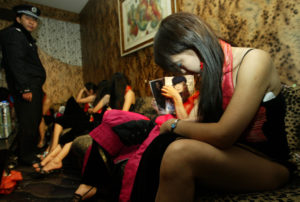
Why the grabby hands? Locals point to Chinese massage parlors and brothels exploding across the city: Apple Spa. KLA Entertainment Center. Chinese Beauity [sic] Parlour, which sits across the street from the European Union’s offices.
The influx of Chinese prostitutes is a continent-wide phenomenon, argues Basile Ndjio, the author of a forthcoming paper in Urban Studies. He estimates that between 13,000 to 18,500 Chinese sex workers are currently in sub-Saharan Africa.
As China moves into Africa — building highways and stadiums, striking oil deals, and opening special economic zones — practitioners of the world’s oldest profession have followed, catering to both Chinese expatriates and locals. Growing African purchasing power helps explain sex migration. Deloitte estimates that Africa’s middle class has tripled over the last three decades. That means more money for imported televisions, imported handbags and, yes, imported sex. Africa is “a new El Dorado for the prostitution business,” Ndjio writes.
Ndjio, an anthropology professor at the University of Douala in Cameroon, is perhaps the only academic studying the phenomenon. He stumbled on his specialty by accident while putting himself through graduate school in Cameroon with work as a casino croupier. Dealing hands of blackjack and poker to Chinese expatriates, he learned through boozy conversation and late-night confession that “Shanghai beauties” — as they are known in Cameroon — congregated in the back rooms of Chinese restaurants, hotels and lounges.
Gamblers taught him the code words – asking for “stress relief,” “rest” or “acupuncture”— to go behind the curtain and penetrate the cliquish, guarded world of Chinese expatriates in Africa. Prior to his current paper, Ndjio has over the past six years authored two of the only studies on Chinese sex migration to Africa.
Read more at www.qz.com


