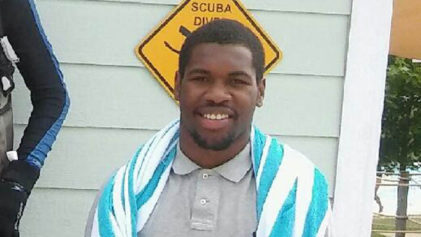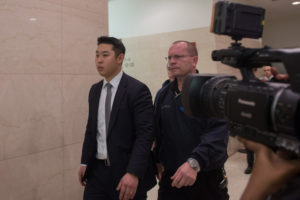
Officer Peter Liang exiting court this afternoon. He is charged with manslaughter and other offenses in the death of Akai Gurley. (Bryan R. Smith/ The New York Times)
During court testimony, New York Police Department officer Peter Liang, currently facing manslaughter and official misconduct charges over the death of Akai Gurley, broke down in tears.
Liang also expressed fear about performing a patrol in the crime-ridden Brooklyn housing project where he accidentally shot Gurley. Gurley was killed after an accidental discharge from Liang’s gun ricocheted off a wall and struck him.
According to The New York Times, Liang, a rookie cop, was performing a patrol with his partner Shaun Landau. He had his gun out and his finger was on the trigger. He tensed up when he was startled by a sound and the gun went off. However, Liang was already afraid to enter the housing project, where two cops had already been shot.
“There are bullet holes in the roof, there is evidence of drugs, there is drug dealing, people get assaulted and raped in these areas,” he said.
The prosecution accused Liang and his partner of failing to provide CPR to the ailing Gurley. Liang said he had received little training in CPR while he was at the police academy. According to NBC News, the prosecution also criticized Liang for unholstering his weapon during the patrol, but he replied this was a necessary precaution.
“When you fear for you and your partner’s safety, I would take my weapon out,” Liang said.
Liang’s testimony raises several questions. For example, why did the NYPD decide to send a rookie cop, who was obviously terrified, to patrol a dangerous housing project?
Police officers often use fear as an excuse when challenged on shooting Black people. Ferguson police officer Darren Wilson said he had to shoot Michael Brown because he displayed “super human” strength and he feared for his life. Another St. Louis-area police, Lt. Ray Albers, was forced to resign after he waved an assault rifle at protesters in Ferguson. According to The Atlanta Blackstar, Albers said he feared for his life when he was approached by several Black men. A ProPublica analysis of federal data showed that young Black men were 21 times more likely to be shot by police as white men.
Police are quick to shoot Black people, but they often bend over backwards to avoid shooting white people who brandish weapons. The militia men who staged an armed occupation of a federal wildlife reserve in Burns, Oregon, seemed to have been treated with kid gloves until police staged a mass arrest. One of the Oregon protesters, Robert “LaVoy” Finicum, was shot dead during a police stop. However, Finicum was only shot after he twice reached for his gun. Cleveland police shot and killed 12-year-old Tamir Rice within seconds of arriving on the scene and never gave him a chance to drop his toy gun.